
9 min read · 1,838 words
There is a particular kind of institutional confidence required to take a sport that has functioned perfectly well for over a century and announce that, actually, it would benefit from being split into four quarters with mandatory stoppages baked in at commercially convenient intervals. FIFA has that confidence in abundance. Whether the rest of the football world shares it is, to put it diplomatically, another matter entirely.
The group stage of the 2026 World Cup has produced its share of genuine drama: Australia grinding out a draw to reach the last 32, Anthony Elanga producing a strike that will be replayed for years, Scotland staring at a spreadsheet and hoping. But the story threading through all of it, the one that has united fans, players and coaches across every conceivable cultural divide, is the four-quarter structure and its attendant hydration breaks. Which are, of course, advertising breaks wearing a sports-science disguise.
The Hydration Break Problem, Stated Plainly
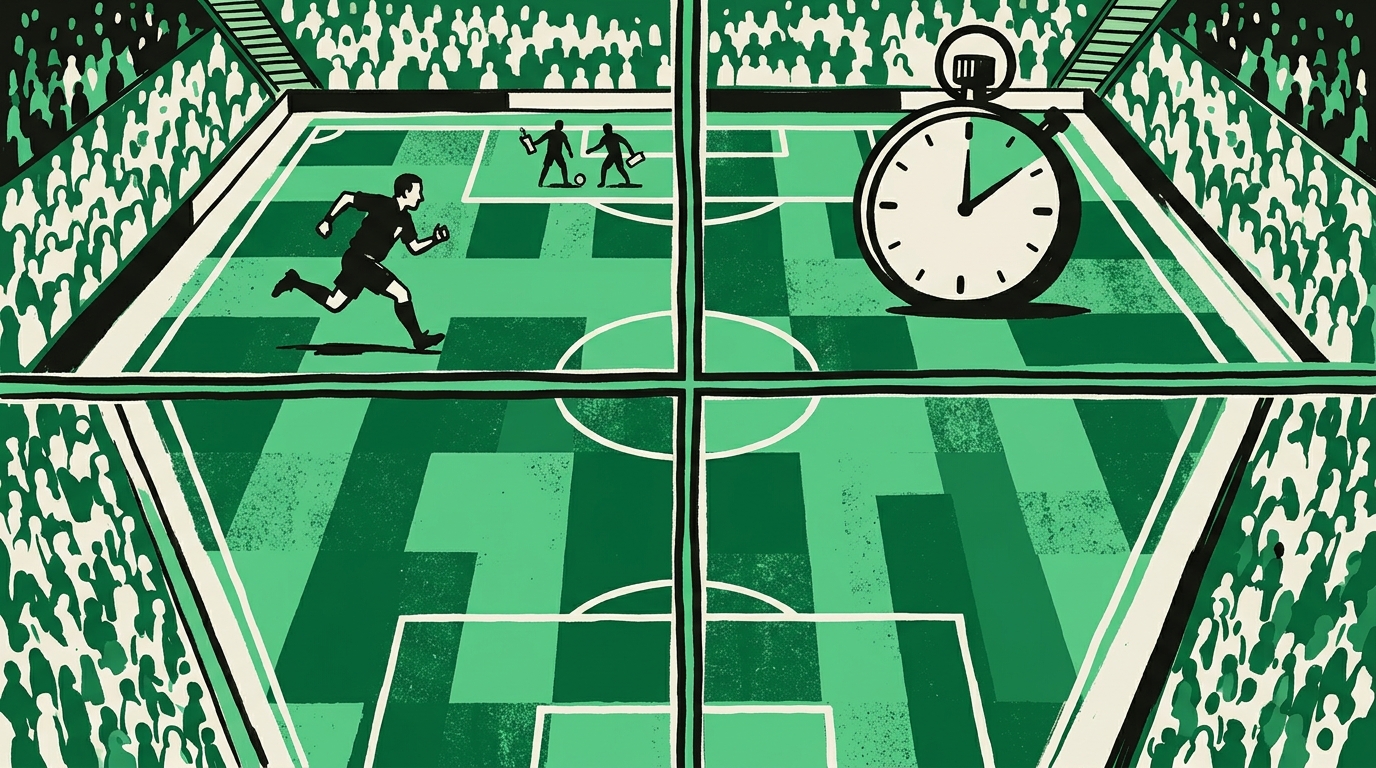
On Tuesday evening in Boston, with England and Ghana on the pitch and an injury delay already in progress, a group of players drifted to the touchline and began taking drinks. The referee intervened with what Barney Ronay in the Guardian described as “apparently genuine outrage” at the spectacle of unofficial hydration. The official break was, by that point, roughly sixty seconds away.
The absurdity is self-evident, but it is worth spelling out the tactical dimension because it goes beyond mere aesthetics. Football’s rhythm is not incidental to the sport; it is structural. A team pressing high and forcing errors relies on the opposition being unable to reorganise. A side defending a narrow lead depends on the attacking team being unable to stop the clock. The four-quarter format hands coaches four guaranteed reset points per match, irrespective of whether the game’s momentum warrants one. That is a fundamental alteration to how the sport operates, not a cosmetic tweak.
The argument FIFA would presumably advance is that the North American summer heat justifies mandatory rest periods. There is something to that in isolation. But the breaks happen regardless of temperature, regardless of game state, and at intervals that align suspiciously neatly with broadcast advertising slots. The Guardian’s reporting makes clear that the commercial choreography is precise: the breaks are cued, the talent is ready, the timing is not accidental. Football supporters are not, as a demographic, easily fooled about when they are being sold something.
Australia Through, Quietly and Without Fuss
If the hydration break controversy provided the tournament’s background noise on Thursday, the foreground offered rather more straightforward drama. Australia’s 0-0 draw with Paraguay in San Francisco secured their place in the last 32 for only the third time in their history, a fact that deserves more prominence than it typically receives in European football coverage.
The Guardian’s match report noted that a much-changed Australia side controlled large portions of the match, which is a polite way of saying that both teams identified the draw as the optimal outcome and proceeded accordingly. Paraguay needed the point to maintain their own qualification hopes; Australia needed it to confirm theirs. The football was not, by any candid assessment, distinguished. But the Socceroos’ ability to manage a game of this kind, with rotated personnel and the pressure of knowing that a defeat would eliminate them, speaks to a squad with more tactical maturity than they are sometimes credited with.
The xG figures for a 0-0 between two sides playing for a draw are rarely illuminating, and this was no exception. What matters is the outcome: Australia are in the knockout rounds, and they got there without the chaos that has characterised some of their previous tournament exits. That is progress, even if the match itself will not feature in any highlight compilations.
Elanga, Japan and the Ghost of Gijón
The Japan-Sweden fixture in Dallas was always going to invite comparisons to football’s most notorious mutually convenient draw, the 1982 West Germany-Austria arrangement in Gijón that eliminated Algeria. The comparison is unfair in one specific sense: this game actually produced two goals worth watching.
Daizen Maeda’s opener was, by multiple accounts, a well-constructed team goal that demonstrated why Japan have been one of the tournament’s more watchable sides. The response from Sweden was Anthony Elanga’s long-range equaliser, which Sky Sports described as stunning, a word that sports journalists deploy with such frequency that it has lost most of its meaning, but which in this instance appears genuinely warranted.
The result confirmed Japan as Group F runners-up, setting up a last-32 meeting with Brazil in Houston. Sweden, finishing third, now navigate a set of permutations that could produce a tie against France or Norway. The Guardian observed that Graham Potter had wanted his side to manage fine margins after their turbulent start to the tournament, and by the final whistle he could embrace his staff knowing the job was done. That is a sentence that captures something real about Potter’s situation: Sweden were not convincing, but they are through, and in a 48-team World Cup, through is what matters.
The Dallas crowd, to their credit, were served enough to justify the ticket price. This was not Gijón. It was, at worst, two teams who happened to share an interest in the same scoreline and, in the second half, produced enough football to make the mutual convenience feel less choreographed than it might have done.
Scotland’s Agonising Wait
And then there is Scotland. Steve Clarke’s side finished third in Group C with three points and a goal difference of minus three, which leaves them in the category of best third-placed finishers, a concept that exists specifically to give teams in their position something to hope for while the rest of the group stage concludes.
The Independent identified six specific results that Scotland require from the remaining group matches to confirm their passage to the last 32. The precise combinations need not be rehearsed here in full, partly because they will be outdated by the time this piece is read, and partly because listing six conditional results is the kind of thing that causes supporters to develop stress-related conditions. The short version is that Scotland can go through, but they need help, and the margin for error is narrow.
The broader point is that Scotland being at a World Cup at all, and being in a position where qualification for the knockout rounds is arithmetically possible, represents genuine progress for Scottish football. That context tends to get lost in the immediate anxiety of the situation. Three points from the group stage is not a disaster when the group contained stronger opposition; minus three on goal difference is a problem, but not an insurmountable one if the results elsewhere cooperate.
Whether they do cooperate is, at time of writing, unknown. Scotland wait. Their supporters, presumably, are watching the other group matches with the particular intensity of people who have no direct influence over events and know it.
The Structural Question That Will Not Go Away
Returning to the hydration breaks, because the tournament will keep returning to them whether analysts choose to engage or not: the question is not whether FIFA will reverse the format for this tournament. They will not. The question is whether the volume of criticism, which has been consistent and cross-cultural rather than confined to the usual European football conservatism, will register before the next cycle.
The format has its defenders. Some coaches have acknowledged that the guaranteed rest periods allow for tactical adjustments that would otherwise require a substitution or an injury. A small number of players have noted that the breaks are genuinely useful in high temperatures. These are not frivolous points. But they do not address the fundamental issue, which is that the breaks interrupt the game’s internal logic at moments determined by broadcast schedules rather than by anything happening on the pitch.
Football has always accommodated commercial interests. Shirt sponsorship, stadium naming rights, the timing of kick-offs adjusted for television audiences across multiple time zones: none of this is new. What is new is the insertion of commercial logic directly into the structure of the ninety minutes, in a way that is visible and legible to anyone watching. The referee sprinting across the pitch to prevent players from taking an unofficial drink, one minute before the official drink, is not a subtle piece of brand integration. It is the mechanism made visible, and it is not a flattering image.
The World Cup 2026 is, by attendance and viewership metrics, a commercial success. The 48-team format has produced more matches and, inevitably, more advertising inventory. Whether it has produced better football is a separate question, and one that the hydration break debate has made harder to avoid. For a full breakdown of the tournament’s tactical themes and how the expanded format is reshaping the knockout rounds, the World Cup 2026 coverage hub has the detail.
For now: Australia are through, Sweden are through, Japan face Brazil, and Scotland are watching other people’s matches with their hearts in their mouths. The hydration breaks will continue, the adverts will run, and the football, when it is allowed to breathe, remains worth watching. That is about as optimistic an assessment as the evidence currently supports.
FAQ
What are the hydration breaks at the 2026 World Cup?
FIFA introduced a four-quarter structure for the 2026 World Cup, dividing each match into four periods with mandatory breaks between them. The breaks are officially justified on heat and player welfare grounds, but their timing aligns with broadcast advertising slots, which has prompted widespread criticism from fans, players and coaches throughout the group stage.
Has Australia qualified for the World Cup 2026 knockout rounds?
Yes. Australia secured their place in the last 32 with a 0-0 draw against Paraguay in San Francisco, qualifying for the knockout stages of the World Cup for the third time in their history. They finished the group stage having managed their resources carefully across a rotated squad.
Who scored for Sweden against Japan and what was the result?
Anthony Elanga scored a long-range equaliser to cancel out Daizen Maeda’s opener for Japan, finishing the match 1-1. The draw confirmed Japan as Group F runners-up and Sweden as third-placed qualifiers. Japan will face Brazil in Houston in the last 32; Sweden’s opponents depend on other group results.
Can Scotland still qualify for the World Cup 2026 last 32?
Scotland finished third in Group C with three points and a goal difference of minus three. They remain in contention as one of the best third-placed finishers, but qualification depends on results in other groups. The Independent identified six specific results Scotland require from the remaining group matches to confirm their progress.
Does the four-quarter format affect football tactics at the World Cup?
Yes, in meaningful ways. The mandatory breaks give coaches four guaranteed reset points per match regardless of game state, which disrupts high-pressing systems that rely on sustained intensity and removes the clock-management disadvantage that teams defending leads would otherwise face. Critics argue this represents a structural alteration to the sport rather than a cosmetic change.
