
9 min read · 1,835 words
There is a particular cruelty in being handed one of the great footballing stages and not quite feeling ready to step onto it. Mexico City has waited decades for this moment, the 2026 World Cup opener, played on home soil, with the Zócalo transformed into a cathedral of screens and noise, and yet, as the Guardian reports the city finds itself arriving at the threshold in a complicated, fractured mood. “Not in our best moment,” as one local put it, with the kind of weary understatement that only makes sense if you know the city well.
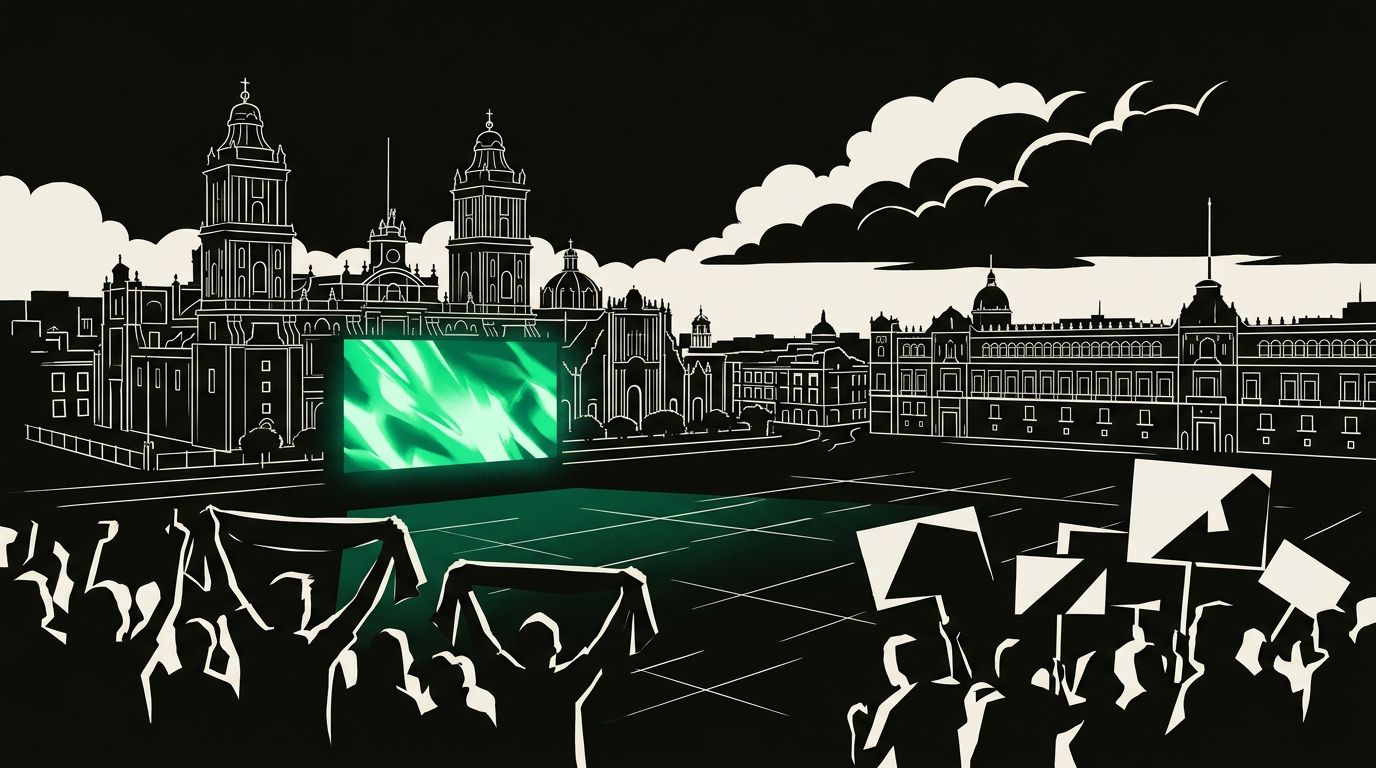
I know it reasonably well. I spent time reporting from the Mexican capital during the 2017 earthquake aftermath and returned several times since. The Zócalo, nobody there calls it the Plaza de la Constitución, not really, is one of those rare urban spaces that carries genuine historical weight without becoming a museum piece. Aztec cosmology placed the Templo Mayor, a single block away, at the literal centre of the universe. Fifa, with characteristic immodesty, has now attempted to make it the centre of the footballing one. A vast video screen dominates the square. The infrastructure of spectacle is in place. What is less certain is whether the spectacle has the city’s full blessing.
The Strike That Refuses to Be Drowned Out
The immediate complication is a teachers’ strike that has been escalating in the days before the tournament’s opening match. This is not a minor inconvenience to be managed by PR teams and fan-zone logistics. Mexican teachers’ unions have a long and serious history of civic protest; their grievances, around pay, conditions, and the chronic underfunding of public education, are structural and deeply felt. The timing, whether coincidental or deliberately chosen for maximum visibility, places the Mexican government in an awkward position: hosting a global festival of soft power while a significant portion of its public-sector workforce is in open dispute.
The Guardian’s ground-level reporting captures what official Fifa communications will not: that residents of the city hold genuinely mixed feelings about the tournament’s arrival. Some feel pride and anticipation. Others feel the investment in fan zones and infrastructure sits uncomfortably against the backdrop of ongoing social tensions. This is not unique to Mexico City, host cities across the 2026 World Cup footprint have faced versions of this tension, but it carries particular resonance here, where inequality is visible and the political temperature rarely drops.
Weather as an Uninvited Guest
Beyond the social friction, there is a more literal disruption looming. The Independent has documented how lightning strikes caused significant delays to matches at last year’s Club World Cup, and the same meteorological risk applies to this tournament. Several of the 2026 venues sit in climatic zones prone to afternoon and evening thunderstorms, particularly during summer months. Fifa’s protocols require play to be suspended when lightning is detected within a certain radius of the stadium, a rule that sounds sensible in isolation but becomes operationally complex when you are managing 48-team group-stage scheduling, broadcaster windows, and hundreds of thousands of travelling supporters.
Mexico City itself sits at 2,240 metres above sea level, which affects both player performance and storm patterns. The thin air has long been a talking point in Mexican football, CONCACAF World Cup qualifiers at the Azteca have historically been brutal for visiting sides precisely because of the altitude, but the combination of elevation and volatile summer weather adds another variable to an already intricate logistical picture. Tournament organisers will be watching forecasts with the kind of anxiety usually reserved for penalty shootouts.
What the Zócalo Cannot Hide
Is the public enthusiasm genuine or manufactured?
Both, probably, and in proportions that vary by neighbourhood and demographic. The fan festival infrastructure in the Zócalo is real, and the crowds gathering around it are real. Mexico has a football culture of extraordinary depth and passion, La Liga is followed obsessively here, the national team commands genuine emotional investment, and the memory of 1986, when Mexico last hosted a World Cup, remains vivid in the collective imagination. But manufactured enthusiasm, the kind produced by official communications, corporate sponsorship, and the sheer visual weight of Fifa branding, can coexist with genuine ambivalence among residents who are not inside the fan zone.
How does the strike affect the tournament’s opening days?
Practically, the immediate disruption may be limited. Strikes of this kind tend to affect transport and public services rather than stadium operations directly. But symbolically, the optics matter. Images of protest banners within sight of World Cup branding are exactly what tournament hosts spend years trying to prevent. Whether Mexican authorities move to contain or accommodate the demonstrations will itself become a story, and in the age of social media, the story of how a protest is handled can travel as far as the matches themselves.
Does Mexico City’s complicated mood reflect broader host-city tensions?
Across the three host nations, the United States, Canada, and Mexico, the expanded 48-team format has created a tournament of unusual geographic spread. Some host cities have embraced the occasion with relatively uncomplicated enthusiasm. Others have found the gap between the tournament’s promotional narrative and local social realities harder to paper over. Mexico City, with its size, its history, and its political complexity, was always going to be one of the more textured stories of the summer. The Guardian’s reporting confirms that texture is very much present.
The Football Itself, and What Surrounds It
It would be a disservice to the tournament to let the contextual noise entirely obscure what is, by any measure, a remarkable footballing occasion. The 2026 World Cup is the first to feature 48 teams, the first to be co-hosted across three nations, and the first to return to Mexican soil in four decades. The Estadio Azteca, one of the most storied grounds in world football, the venue for both the Hand of God and the Goal of the Century in 1986, is hosting matches again, though its condition has been a subject of ongoing concern among observers tracking the stadium’s renovation progress.
The question of who will define the tournament on the pitch remains genuinely open. The Independent’s Golden Ball preview surveys the candidates for the tournament’s individual prize, with the usual constellation of names, Mbappé, Vinicius Jr, Bellingham, featuring prominently in early odds. But World Cups have a habit of producing their own protagonists, players who arrive with modest expectations and leave as symbols of a summer. The 2026 edition has enough structural novelty, the extra group-stage matches, the new round-of-32 format, to create more opportunities for unexpected narratives to emerge.
For Mexico specifically, the tournament carries the weight of host-nation expectation layered onto a programme that has historically stalled at the round of 16. El Quinto Partido, the fifth match, the quarter-final stage that has eluded Mexico in every World Cup since 1986, remains the great unfulfilled ambition of Mexican football. Playing in front of home crowds, at altitude, in a tournament they are co-hosting: if there is ever a moment to break that ceiling, this is structurally it. Whether the team’s preparation has been equal to the occasion is a separate question.
Reading the Room in a Complex City
What strikes me about the Guardian’s reporting, and what Anglo football coverage so often misses about Latin American host cities, is the refusal to flatten the story into either uncritical celebration or cynical dismissal. Mexico City is not simply a backdrop for football. It is a city of 22 million people with its own politics, its own grievances, its own relationship to spectacle and to power. The Zócalo has been a site of protest as often as it has been a site of festivity; those two functions are not mutually exclusive, and the city’s residents understand that in a way that visiting journalists sometimes do not.
The teachers’ strike is not an interruption to the real story of the World Cup in Mexico City. It is part of the real story. A government that has invested heavily in the tournament’s success, politically, financially, reputationally, is now navigating the gap between the image it wants to project and the social realities it cannot fully control. That gap is not unique to Mexico, and it is not new. But it is worth naming clearly, rather than treating it as an unfortunate footnote to the football.
The fan zone will fill. The matches will be played, weather permitting. The Azteca will roar. And somewhere nearby, teachers will be making their case for something that has nothing to do with football and everything to do with what kind of country Mexico is choosing to be. Both things are true at once. The city, as it always has, will hold the contradiction.
For those following the full arc of the summer, the tactical shifts, the emerging stars, the stories that will define the tournament, our summer 2026 storylines guide tracks the key threads as they develop. And for supporters trying to navigate the broadcast landscape across a three-nation, 48-team tournament, our how-to-watch guide covers the options available depending on where you are based. For streaming options, you can also visit our watch page for further detail.
FAQ
Why are teachers striking during the Mexico City World Cup opener?
Mexican teachers’ unions have been engaged in an escalating industrial dispute over pay, working conditions, and public education funding. The timing coincides with the World Cup’s opening days in Mexico City, creating a visible tension between the tournament’s celebratory atmosphere and ongoing domestic social grievances.
How could lightning delays affect World Cup 2026 matches?
Fifa protocols require matches to be suspended when lightning is detected within a defined radius of the stadium. Several 2026 venues, including those in summer storm-prone regions, face this risk. As the Independent notes last year’s Club World Cup saw multiple matches disrupted by exactly this scenario, and the expanded 48-team schedule leaves limited buffer for rescheduling.
What is the Zócalo and why is it significant for the World Cup?
The Zócalo, formally the Plaza de la Constitución, is one of the largest city squares in the world, located in Mexico City’s historic centre adjacent to the Templo Mayor of the ancient Aztec capital. Fifa has converted it into the city’s official fan festival zone, with a massive video screen installed for the tournament.
What is Mexico’s World Cup ambition as a host nation?
Mexico has not advanced beyond the round of 16 in any World Cup since 1986, the last time they hosted the tournament. Known domestically as reaching El Quinto Partido (the fifth match, or quarter-final), breaking that barrier on home soil in 2026 is the defining ambition of the current generation of Mexican players and supporters.
How does Mexico City’s altitude affect World Cup football?
At 2,240 metres above sea level, Mexico City presents significant physical challenges for visiting teams unaccustomed to the thin air. The altitude reduces oxygen availability, affecting endurance and recovery. It has historically been a major factor in CONCACAF qualifying matches at the Azteca and will similarly influence group-stage and knockout matches hosted there this summer.
