
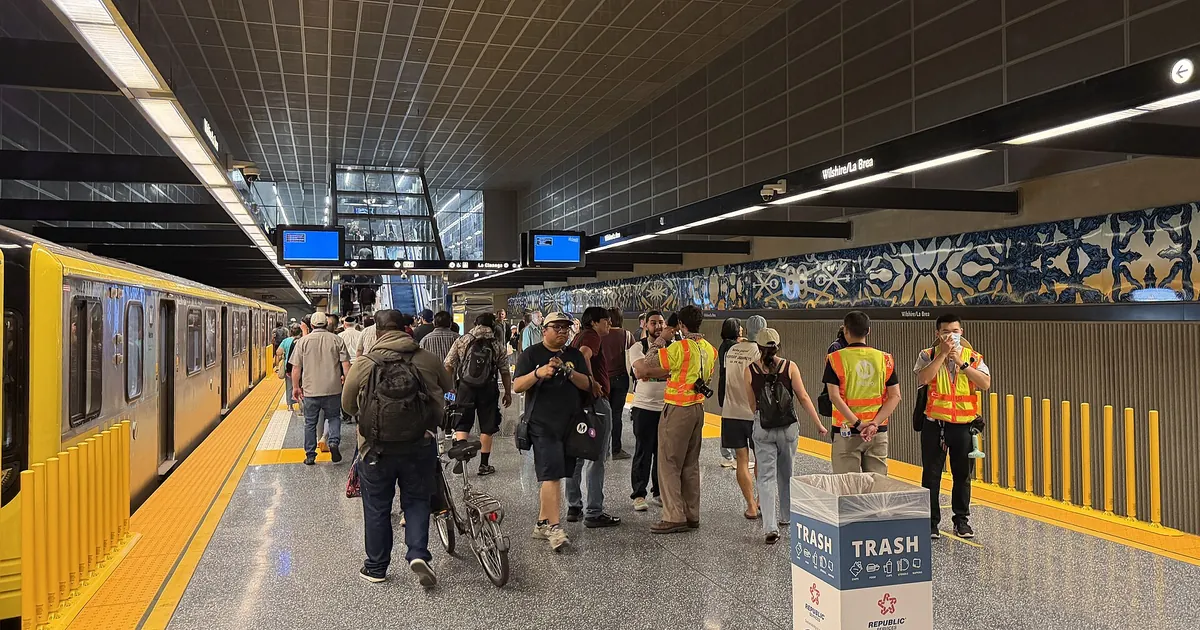
LA Metro rail infrastructure feeding World Cup 2026 stadium crowds. Photo: DJTechYT / Wikimedia Commons, CC BY-SA 4.0
5 min read · 945 words
Los Angeles Metro has spent this World Cup running an experiment nobody outside the transit-planning world was watching closely: can a city built entirely around the car actually move a stadium crowd without one? The early numbers are good. The gap between what just got tested and what the 2028 Olympics will actually require is bigger than the headlines about it suggest.
When Spain played Austria at SoFi Stadium on July 2, Metro logged nearly 50,000 rail rides and more than 30,000 shuttle rides tied to that single match, according to an Associated Press report. That’s one of the busiest transit days in the region’s recent history, built around one game, at one stadium, on one afternoon.
The Ramp-Up Was Real
The July 2 numbers weren’t a fluke. LAist tracked the climb match by match: 18,551 shuttle rides for the tournament-opening USA-Paraguay game, rising to more than 29,000 for Iran-Belgium, then past 30,000 by the Spain-Austria quarterfinal. Combined, Metro says it has logged over 100,000 rides on its dedicated $1.75 SoFi shuttles across the tournament’s first four matches at the venue. On top of that, rail ridership on lines serving the stadium jumped 41% on the K Line and 23% on the C Line compared to a typical Monday, LAist reported, when Iran played New Zealand there in June.
Metro built 15 shuttle lines to feed fans into SoFi from park-and-ride hubs as far out as Newport Beach, well south of the stadium. The longest of those routes runs an hour and 15 minutes each way. Jennifer Vides, Metro’s chief customer experience officer, framed the whole push in a phrase the agency clearly wants people to remember: “LA is a transit city.”
The Part That Doesn’t Scale by Simple Math
Here’s the original problem nobody’s flagged yet. The World Cup ran eight matches at one stadium, spread across five weeks, with kickoffs staggered so Metro never had to move two stadium crowds through the same rail lines at the same hour. To pull that off, the agency borrowed about 200 buses. For the 2028 Olympics, officials say they’ll need roughly 3,000, a fifteen-fold jump.
That’s not just “more of the same system, scaled up.” The 2028 Games have been sold from the start as a “no car” Olympics: no parking for spectators at any venue, full stop, with every fan routed onto transit or a shuttle regardless of how far they’re traveling or how badly they’d rather drive. The World Cup never tested that. Fans who didn’t want to ride 75 minutes from Newport Beach could still drive, pay for parking, or take a rideshare. The Olympics won’t offer that option. What Metro actually validated this summer was transit as an attractive choice at a discount fare. What 2028 requires is transit as the only choice, at Olympic-scale volume, across dozens of venues running simultaneously instead of one stadium running sequentially.
The bus math raises a second question none of the coverage so far has asked: where do 3,000 buses actually come from. The 200 Metro borrowed for the World Cup came from other California transit agencies with slack capacity on non-peak days, the same basic favor-trading that’s let host cities elsewhere patch together temporary systems all tournament. An Olympics is a fixed, immovable date on the calendar. Every agency that might lend LA a bus fleet in 2028 will be running its own normal summer service that same week, not sitting on spare capacity the way a mid-week World Cup group match allows. Sourcing fifteen times the fleet, with drivers certified to run it, isn’t only a bigger version of what worked this month. It may require a genuinely different sourcing model, whether that’s out-of-state contracts, private charter fleets, or buying rather than borrowing. Metro hasn’t said publicly which route it’s planning, and FootyGazette isn’t aware of reporting that answers it yet.
There’s a genuine bright spot buried in the infrastructure numbers. The D Line extension opened in June, pushing service west through Koreatown toward the Grove, LACMA, and the La Brea Tar Pits. Four more stations are already under construction to stretch the line to UCLA, which will serve as the Olympic Athletes’ Village. That’s a piece of permanent infrastructure the World Cup leaves behind regardless of how the bus math shakes out, unlike the borrowed shuttle fleet, which goes back to wherever it came from once the tournament ends.
What’s Still an Open Question
Metro is also citing a 13.6% drop in overall crime compared to the same period last year and standing up its own transit police force, with full deployment targeted for 2029, a year after the Games. Whether that timeline holds, and whether a system whose shuttle ridership jumped more than 50% between the first two matches, then leveled off closer to the ceiling by the quarterfinal, can keep pace with what the Olympics will demand, isn’t something FootyGazette or anyone else can verify in advance. It’s a fair question, not a settled one.
What the World Cup proved is that Angelenos will ride the train and the shuttle bus when the alternative is a parking lot and a long walk. What it didn’t prove is whether that holds when there’s no parking lot left to compare it to, at dozens of venues instead of one, all running at once. Los Angeles has five weeks of real data now, and a permanent D Line extension it didn’t have in June. It also has two years left to close a gap that’s measured in thousands of buses, not hundreds, and a fleet-sourcing question it hasn’t answered publicly yet.
For more on how World Cup host cities are handling transit at scale, see FootyGazette’s coverage of Seattle’s car-free downtown zone and the transit-legacy split between Houston and Kansas City, part of the full World Cup 2026 fan guide.
