
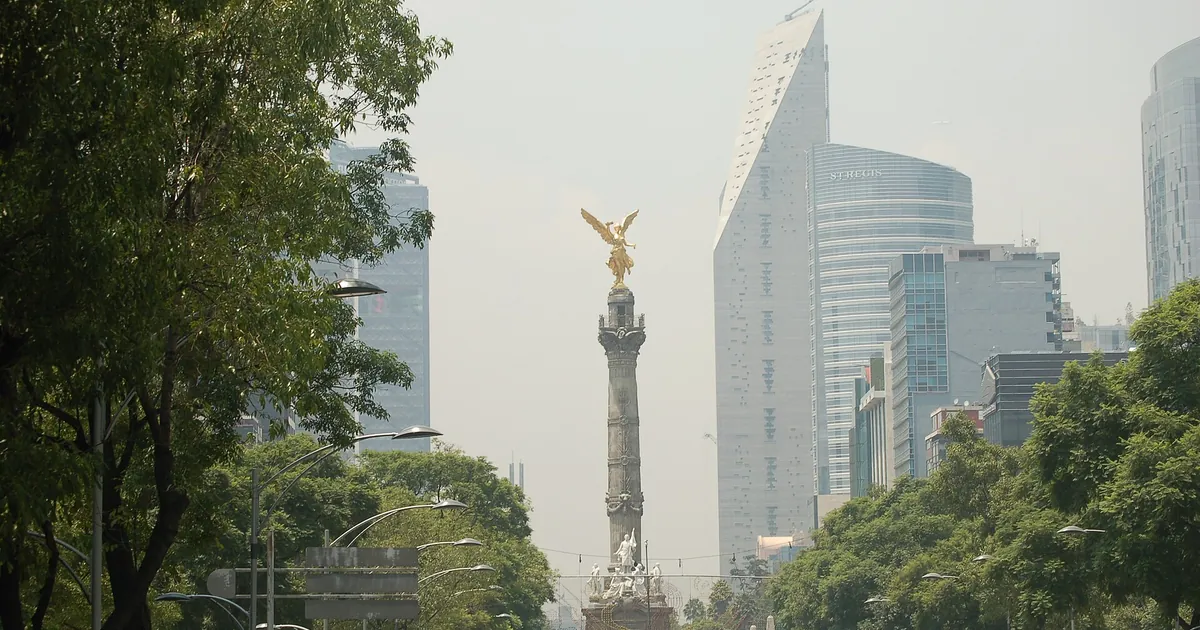
Angel of Independence, Mexico City. Photo: Jpesch95 / Wikimedia Commons, CC BY-SA 4.0
7 min read · 1,499 words
World Cup 2026 Mexico City Celebration Deaths Expose FIFA’s Perimeter Blind Spot
Three people suffocated on a downtown Mexico City street early Wednesday morning, in a crowd that had nothing to do with a stadium. The World Cup 2026 Mexico City celebration deaths came hours after El Tri beat Ecuador 2-0 to reach the round of 16, when thousands of fans packed the intersection of Hamburgo and Lancaster streets near the Angel of Independence monument on Paseo de la Reforma. A 44-year-old man and a 19-year-old woman died of suffocation on the spot. A 48-year-old woman was pulled out unconscious, treated for asphyxiation, and later died in hospital. The capital’s health secretariat confirmed all three deaths in the early hours of July 1, after paramedics performed CPR and advanced resuscitation at the scene.
Mayor Clara Brugada posted her condolences on X and asked residents to “always celebrate with responsibility, care, and empathy.” It’s a decent sentiment, and it is also the entire public response so far, six months into a security operation that has spent enormous money on almost everything except this. Nobody planned for a monument roundabout to become the most dangerous place in the city for three families on the night their team won.
What Happened Near the Angel of Independence
Mexico’s win pushed a nation with a 40-year knockout-round wait into the last 16, and Estadio Azteca has been a fortress all tournament: four wins, zero goals conceded. That form matters here, because the bigger Mexico’s run gets, the bigger these street gatherings get too. Reforma is the default gathering point whenever the national team wins something worth celebrating, and it has been for as long as most fans can remember. Storms had delayed kickoff by an hour, pushing the final whistle, and the street celebration that followed, later into the night.
There was no ticket for that intersection. No gate, no counted capacity, no staff checking how many people the space could safely hold. By some estimates, over a million people were out across the capital that night, not all of them anywhere near Reforma, but enough of them converging on the same few blocks that the junction couldn’t absorb the density. People arrived from every direction until the crowd simply had nowhere left to compress into, and three of them didn’t walk away.
This Wasn’t the Tournament’s First Warning
It also wasn’t Mexico’s first scare of the tournament. On June 24, after Mexico beat Czechia 3-0 to close out the group stage, a driver accelerated into a crowd celebrating on a boulevard in Cabo San Lucas, roughly 1,600 miles from the capital, after being surrounded by fans pressing on the vehicle. Seventeen people needed medical treatment; the crowd had already dragged the driver out before police arrived. Cabo San Lucas isn’t a World Cup host city. It doesn’t have a stadium, a fan zone, or a single FIFA credential checkpoint anywhere near it, and it never appears on any host-city security budget line. The celebration happened anyway, because the team winning matters more to fans than whether FIFA built any infrastructure for that particular street, in that particular resort town, on that particular night.
Opening night carried the same warning inside the tournament’s own footprint. On June 11, thousands rushed Mexico City’s official fan zone before organizers declared it full at roughly 50,000 people, while anti-government protesters clashed with riot police outside Estadio Azteca during the opening ceremony. A man reportedly suffered a heart attack in the crush, and medics struggled to reach him through the crowd. Three incidents, three different Mexican settings, one shared feature: none of them happened inside a ticketed, gated space that anyone had actually engineered for a surge of people.
Why the World Cup 2026 Mexico City Celebration Deaths Weren’t a Surprise
FIFA and its host governments built one of the most extensive event-security operations in sports history for this tournament: CCTV networks, facial recognition, kilometer-plus perimeters, and coordinated federal-local policing at every venue, layered under a counter-drone and airspace-monitoring regime. The scale is documented in dollars. ESPN’s pre-tournament reporting on the security buildout put U.S. federal grants to host cities at roughly $625 million for overtime and security costs, with more than $250 million of that earmarked specifically for anti-drone technology, and cited a single Los Angeles sheriff’s department projecting $2.7 million in overtime for its own jurisdiction alone. The same reporting counted more than 400 law enforcement agencies coordinating across the tournament footprint, some running joint drone-mitigation training out of an FBI facility.
That planning explicitly named its “soft targets”: hotels, team base camps, restaurants, fan festivals, block parties, transportation networks, parking lots. It’s a genuinely broad list, and credit where due, organizers thought about far more than the 90 minutes on the pitch. But every item on it is a named, mapped location somebody could staff in advance. A monument roundabout that fills with an unplanned crowd overnight because a team won isn’t a block party with a permit. It’s the gap between the list and reality.
Security researchers flagged that exact gap months before a ball was kicked. Police Chief Magazine warned in its pre-tournament coverage that policing success “will not be judged solely by what happens inside stadiums” but by how host cities manage “the spaces beyond the venue perimeter, the places where supporters gather, celebrate, and sometimes clash,” adding that nightlife districts and public squares “are not designed for surge capacity and lack structured entry controls.” That’s close to a precise description of Reforma overnight into July 1, written down before the tournament even started.
A Plea Isn’t a Plan
Line up the two responses side by side. Inside the perimeter, Mexico and its co-hosts deployed drone teams, facial recognition, and coordinated multi-agency patrols months in advance, part of a reported 100,000-plus soldiers, sailors, and police mobilized nationally for the tournament, backed by hundreds of millions in federal grants. The Inglewood Police Department alone budgeted $5.7 million for local law enforcement and EMS around SoFi Stadium; the Los Angeles County Sheriff’s Department projected $2.7 million in overtime on top of that, for one venue. Outside the perimeter, the response to three deaths on a public monument was a mayor’s social media post asking people to be careful. That gap is the real story here. Nobody designed Reforma’s celebration crowds to be dangerous, and nobody was deliberately negligent on Tuesday night. But nobody owns the problem either, and an unowned problem tends to produce roughly the same outcome as negligence.
This site has already documented one version of that funding pattern: the federal money flowing into host cities for fan festivals is explicitly security money, not party money, which is exactly why cities have been trimming free fan-zone hours and charging admission to cover the rest. Street celebrations don’t even get that much. There’s no line item anywhere for a monument that spontaneously becomes the largest gathering in the city because a team advanced. The money finds hotels, team camps, and permitted block parties because those appear on a planning document months ahead of kickoff. A crowd that assembles itself in real time, on a street nobody reserved, isn’t on anyone’s document at all.
To be fair to Mexico City, there isn’t an obvious clean fix for a self-organizing crowd of thousands that assembles with no advance notice on a public monument. You can’t ticket a spontaneous street party or run everyone through a metal detector on Paseo de la Reforma. That’s a genuine limitation, not a talking point. But acknowledging the difficulty is different from doing nothing, and the gap between FIFA’s stadium-grade security spending and its complete silence on street celebrations suggests nobody with real resources has tried seriously to close it.
What Happens If Mexico Keeps Winning
This isn’t a hypothetical for next month. Mexico is unbeaten, defensively uncracked, and already scheduled to play its round of 16 match at Estadio Ciudad de México on Sunday, July 5, against the winner of England and DR Congo. If El Tri wins that one too, the earliest a bigger version of Tuesday night could happen is four days from now, at the same stadium, in the same city, on the same streets. A run to the quarterfinals or further would put an even larger, later, denser crowd on the same unticketed corners, right as the broadcast spotlight and the security apparatus both stay fixed on the stadium eight miles away.
As of Wednesday, FIFA itself had said nothing public about the deaths. That’s a smaller omission than a missing safety plan, but it fits the pattern: the tournament’s governing body talks in granular detail about ticketing, dynamic pricing, and stadium operations, and goes quiet the moment the subject moves past the turnstile. Three deaths on a Wednesday night were, by the warnings written down before this tournament even began, close to the predictable version of this story. The bigger version is still ahead of it, on a bigger night, with a bigger crowd, and so far nobody outside Mexico City’s own government has said what actually changes before it happens again.
