
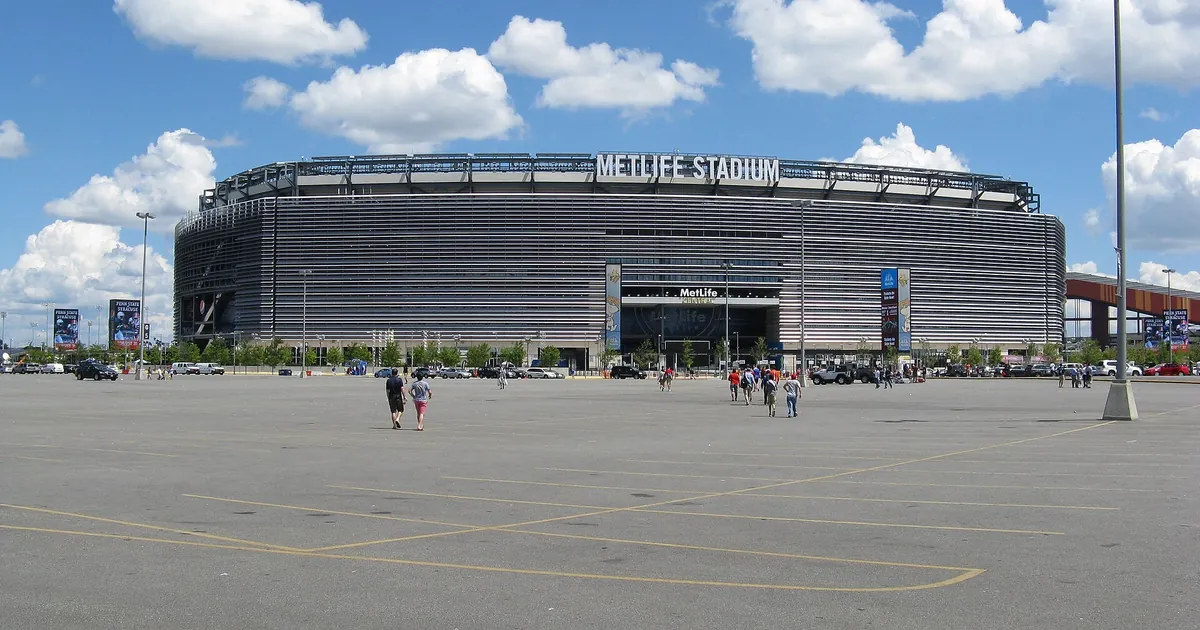
MetLife Stadium pitch. Photo: Alen Ištoković / Wikimedia Commons, CC BY 3.0
7 min read · 1,476 words
The most consistent criticism of the 2026 World Cup so far hasn’t come from pundits. It’s come from the players’ feet. After a run of matches at MetLife Stadium, the venue booked for the July 19 final, France and Brazil internationals have openly questioned whether the surface is fit for the tournament’s biggest games. These World Cup 2026 pitch problems are not a cosmetic gripe about a few dry patches. They go to how the ball moves, how fast the game can be played, and which teams the surface quietly punishes.
FIFA insists everything is fine. The players describe something else entirely. Both can’t be right, and the gap between the engineering brochure and the studs going into the turf is the real story.
What the players actually said about the World Cup 2026 pitch
France midfielder Adrien Rabiot was blunt after his side’s group game, in comments reported by Yahoo Sports. “The pitch, I don’t even know if you can call it that,” he said. “It felt more like an artificial surface, quite hard and quite rigid.” His manager, Didier Deschamps, was more technical, and more revealing. “The fact there’s a concrete slab underneath means the grass fibres are very short,” Deschamps explained. “The bounce is different and the turf changes depending on how much it’s watered.” He added that his players chose not to wear screw-in studs “because there isn’t much depth” to grip into.
Brazil’s Vinicius Junior described the in-game effect rather than the construction. “In the second half, with the heat, the pitch dries out very quickly,” he said. “The game becomes very sluggish, and we can’t get into our rhythm.” That last phrase is the one worth holding onto. A forward of his profile isn’t complaining about comfort. He’s telling you the surface is changing the type of football his team can play.
The complaints are not isolated to one nation having a bad night. Local coverage in New York and New Jersey, including amNewYork’s report on Deschamps’ assessment, captured players and coaches across multiple squads raising concerns serious enough to ask the obvious question out loud: is this pitch fit to host a World Cup final? It’s a fair one to put to the venue that also dominates our MetLife access guide for the same reason. The stadium keeps generating problems it was never built to solve.
The engineering behind the grass, and where it strains
MetLife is, by design, an artificial-turf NFL stadium. To host the World Cup it had to grow a natural pitch on top of a base never built for one. According to CBS Sports’ breakdown of FIFA’s pitch programme, the synthetic infrastructure stays in place at the bottom, with roughly two feet of sand, a full irrigation system and a vacuum ventilation rig laid above it, topped with Tahoma 31 Bermudagrass grown at a North Carolina turf farm and reinforced with hybrid fibres. On paper that’s a serious build, not a roll of sod thrown over plastic.
The problem is that a warm-season Bermudagrass sitting on a shallow, sand-based, heavily engineered shelf behaves nothing like a deep-rooted European football pitch. Short fibres and a firm sub-base mean the ball skids and sits up differently than players expect. The surface also lives or dies by its watering schedule: soak it and it grips, let the summer sun bake it through a long second half and it firms up and slows the ball, exactly the sequence Vinicius described. The same heat driving that is the one fans are battling in the stands, as our World Cup heat survival guide lays out. Deschamps’ “concrete slab” is almost certainly the firmness of that shallow base telegraphing through the grass, not literal exposed concrete. Either way, his players felt it, and changed their boots because of it.
The contradiction FIFA won’t address
Here is the part the official line skates over: this is the fix, not the problem. The 2024 Copa America in the United States was, in Argentina goalkeeper Emiliano Martinez’s word, “a disaster,” with makeshift grass overlays laid in seamed sections that came apart underfoot and MetLife itself showing brown patches. FIFA treated that as a warning and responded by mandating proper natural grass at every 2026 venue, including the synthetic NFL stadiums, and by running its multi-year research programme. The hard, dry, rigid surface players are now describing isn’t FIFA failing to act. It’s the result of the action it took.
That’s the variable nobody at FIFA wants to name. A showpiece final is one match on a freshly peaked surface. A World Cup is a venue hosting fixture after fixture, relaying and recovering grass on a clock, through peak American summer heat, on a base with limited soil depth and no natural drainage of its own. Several stadiums also couldn’t install their turf until late May because of packed concert and event calendars, leaving the roots too little time to knit. Warm-season Bermuda is chosen precisely because it tolerates that heat, but tolerating heat and offering a true, consistent rolling surface for elite passing teams are not the same thing. The grass is the upgrade everyone asked for after 2024, and the players are still reporting the difference.
FIFA’s response, issued to Sports Illustrated and others, leaned on process rather than rebuttal. The governing body said it had invested “more than five years in meticulous and collaborative research” and that the pitches at all 16 stadiums “remain in excellent condition from both a playability and player safety perspective.” It also offered a tell: “Variations in the appearance of some surfaces… do not necessarily reflect the quality, health or playability of the pitch.” That’s a defence built around safety and appearance. It is not an answer to a striker saying the ball won’t run for him.
Why this is a tactical problem, not a comfort one
Strip out the grumbling and there’s a genuine competitive issue underneath. A slow, firm, unpredictable surface flattens the very thing the best teams at this World Cup rely on: quick, low, one-touch combination play where the first touch has to be trusted blind. Spain, Brazil and France build their attacks on the assumption that a ball played into feet arrives the way it left. When the bounce changes match to match and the surface dries mid-game, that assumption breaks, control drops a fraction, and pressing teams pounce on the loose touches. A direct, physical side that bypasses midfield with longer passes barely notices. A possession side trying to play through the lines pays for it.
That’s why “we can’t get into our rhythm” should be read as a tactical warning, not a loser’s excuse. If the MetLife surface keeps behaving this way, it doesn’t just inconvenience the technical sides. It actively narrows the kind of football that can win there, which is a strange outcome for a stadium chosen to stage the final of a tournament that markets itself on the world’s best footballers doing their best work.
What it means for July 19
The final will almost certainly be played on the best version of this pitch FIFA can produce, because it will get the full recovery window a knockout schedule allows. The groups are the stress test, and the groups are where the complaints are landing. If the two finalists are passing teams, the surface becomes a live variable in the biggest match of the cycle, the kind of factor that should be settled by preparation and is instead being argued about on the record three weeks out.
FIFA has five years of research on its side. The players have their feet. For now, the feet are winning the argument.
For the full tournament picture, from venues to viewing, start with our World Cup 2026 guide.
Frequently asked questions
Why are players complaining about the World Cup 2026 pitch at MetLife Stadium?
Because the natural grass is grown on a shallow, engineered base over the stadium’s artificial turf. Players including Adrien Rabiot and Vinicius Junior say the surface plays hard, dry and slow, with an unpredictable bounce and too little depth for normal studs.
Is MetLife Stadium’s pitch real grass?
Yes. It’s Tahoma 31 Bermudagrass reinforced with hybrid fibres, laid over roughly two feet of sand with irrigation and ventilation on top of the existing synthetic base. It’s natural grass, but on an artificial foundation rather than open ground.
Will the World Cup 2026 final pitch be a problem?
The July 19 final will get the longest recovery window of the tournament, so it should be in the best condition possible. The bigger test is the dense group-stage schedule, where repeated matches and summer heat are when the criticism has spiked.
What did FIFA say about the pitch complaints?
FIFA said it spent more than five years researching the surfaces and that all 16 pitches remain in “excellent condition” for playability and safety, adding that how a pitch looks doesn’t necessarily reflect how it plays.
