
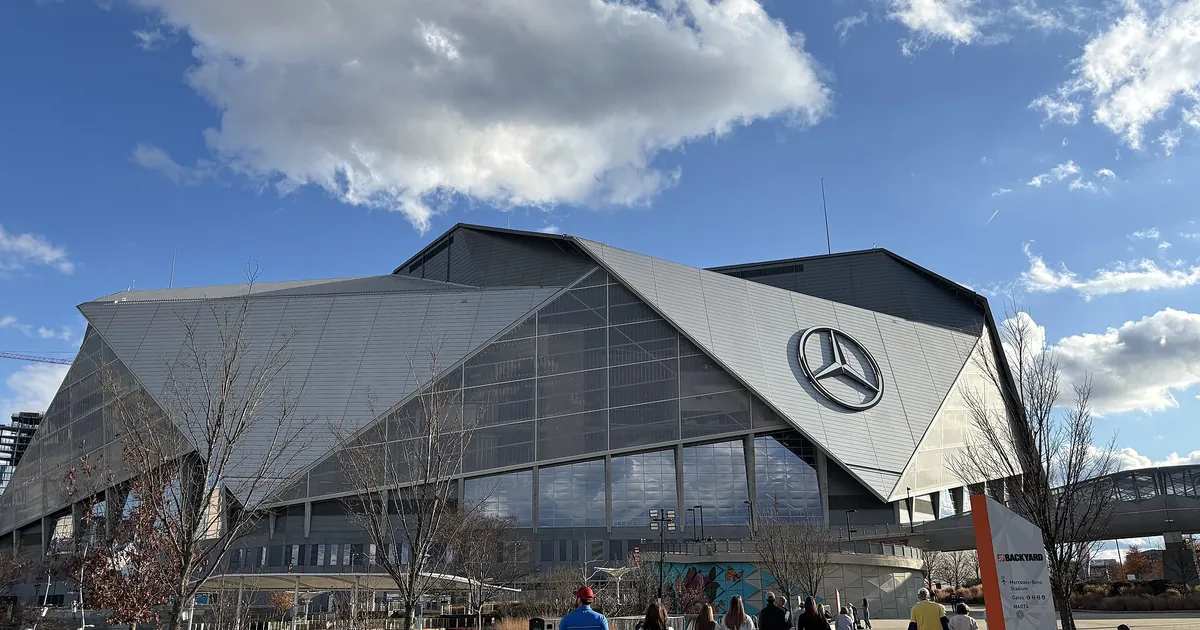
Mercedes-Benz Stadium, Atlanta. Photo: BullDawg2021 / Wikimedia Commons, CC BY 4.0
6 min read · 1,186 words
Atlanta Stadium just collected a title no other World Cup 2026 host venue can claim. USA Today ranked it the best of all 16, ahead of Los Angeles’s SoFi Stadium and Mexico City’s Estadio Azteca. Read the reasoning and one advantage keeps surfacing underneath the roof and the video board: you can get to this one on a train. MARTA drops fans at the door, which in this tournament has become a genuine luxury. So why are Atlanta’s own commuters being handed survival guides for the next month, and why does the city’s transit readiness still carry a quiet asterisk?
The answer is the most interesting thing about Atlanta’s World Cup, and it has almost nothing to do with whether the trains run on time.
The one venue where the train actually reaches the door
Three rail stations serve the stadium, according to MARTA’s own World Cup guidance: SEC District (the rebranded GWCC/CNN Center stop), which sits right at the venue; Vine City, linked by a pedestrian bridge; and Five Points, the system’s central interchange a short walk east. The airport connection is the part visitors struggle to believe. MARTA rail runs from inside Hartsfield-Jackson, so a fan landing from abroad can follow the signs at baggage claim and ride to downtown in roughly 20 to 25 minutes for a flat $2.50 each way.
MARTA has layered tournament prep on top of that geography. The agency plans high-frequency trains roughly every five minutes on match days, new rail cars, an upgraded Better Breeze payment system that lets riders tap a bank card or phone and skip the vending-machine queue, limited FIFA-branded Breeze cards, a new bus rapid transit line, and multilingual Transit Ambassadors in MARTA-branded soccer jerseys. Interim general manager and CEO Jonathan Hunt put the readiness question bluntly to FOX 5 Atlanta: “Will MARTA be World Cup ready? And our resounding answer to that is yes.” He pointed to violent crime on the system falling 50% over six years and overall crime down 28% in a single year.
Atlanta won the crown by comparison
It is worth being clear about how Atlanta earned its number one ranking. USA Today praised the retractable roof, the halo video board and the city’s fanbases. The telling detail sits at the other end of the list. The venue it placed dead last, 16th of 16, was MetLife Stadium, dismissed as “hard to get to.” We have walked through exactly why that is in our look at MetLife’s closed-loop access regime, and the contrast is the real story. Atlanta did not just out-design the field. It out-commuted it. A chunk of its best-venue crown is a transit crown awarded by elimination.
The Atlanta Stadium World Cup 2026 transport problem flips the failure mode
Here is the original point most match-day guides miss. The host-city access failures we have tracked all break at the same place: the last mile. Kansas City’s Arrowhead has no rail at all. Miami’s Hard Rock bans walk-ups and strands fans a mile out at first-come shuttle lots. Gillette offers $80 trains and not much else. Those venues were built car-first and retrofitted for a tournament that arrived by public transport.
Atlanta does not have that problem, and that is precisely why its risk is different. When the train genuinely reaches the door, the danger migrates upstream. It becomes concentration: tens of thousands of fans funneled through a single downtown spine and the Five Points interchange in the same post-match window, in a city whose residents historically underuse the very system now being asked to absorb a World Cup crowd. The failure mode is not abandonment. It is crush, and it is unfamiliarity. That puts Atlanta in the same small cohort as Seattle, the car-free control case, and Mexico City, where rail to the door simply moves the pressure point from the road to the platform.
The “MARTA problem” isn’t really about the match
That reframing explains the survival guides. The wave of “game plan for commuters” coverage, including WABE’s commuter rundown, is aimed less at fans than at the city’s regular nine-to-five downtown workforce, who now share their platforms with match crowds, road closures and a month of disruption they did not buy tickets for. The “MARTA problem,” in other words, is a collision problem. The agency can be entirely correct that it will move fans efficiently to the stadium and still leave downtown Atlanta feeling squeezed, because the constraint was never the stadium trip. It was everything happening around it at the same time.
None of this means the skepticism is unfair. A system can be ready on paper and still wobble the first time tens of thousands of people who have never tapped a Breeze card try to leave at once. Readiness here is a behavior question as much as an engineering one, and behavior is the variable MARTA controls least.
What it means for your matchday in Atlanta
The practical takeaways, ranked by how much friction they remove:
- Take the train, and aim for SEC District. It is the closest stop to the stadium. Vine City and Five Points are the relief valves if SEC District is mobbed.
- Set up payment before you reach the platform. Load a virtual Breeze card or confirm your bank card and phone wallet work. The post-match queue is where the system slows, not the train.
- Use the airport line. Hartsfield-Jackson to downtown by rail is the single easiest leg of any fan’s trip at this World Cup. Skip the rideshare surge.
- Park and ride if you are driving in. Free parking sits at 23 outlying rail stations. Leave the car there and let the train handle the last few miles.
- Build a buffer for the exit, not the arrival. Budgeting 30 to 45 minutes to clear Five Points after the final whistle is a sensible planning figure (our estimate, not a MARTA one), and you will be pleasantly surprised if you beat it.
Atlanta has the venue, the roof and now the ranking. It also has the rare luxury of a stadium you can actually catch a train to. The test over the next month is not whether MARTA can carry the load. It is whether a tournament can borrow a transit culture the host city has never fully built for itself, and hand it back in one piece on 19 July.
FAQ
What is the best way to get to Atlanta Stadium for the World Cup 2026?
MARTA rail is the recommended option. SEC District Station sits at the stadium, with Vine City and Five Points as nearby alternatives, and a flat $2.50 fare each way. The airport line connects Hartsfield-Jackson directly to downtown.
How often will MARTA trains run on match days?
MARTA plans high-frequency service of roughly one train every five minutes on World Cup match days, alongside new rail cars, extra officers and the upgraded Better Breeze payment system.
Why was Atlanta Stadium named the best World Cup 2026 venue?
USA Today cited the retractable roof, the video board and Atlanta’s fanbases, ranking it first of 16 ahead of SoFi Stadium and Estadio Azteca. Its downtown location and rail access were a recurring advantage, in sharp contrast to last-placed MetLife Stadium.
