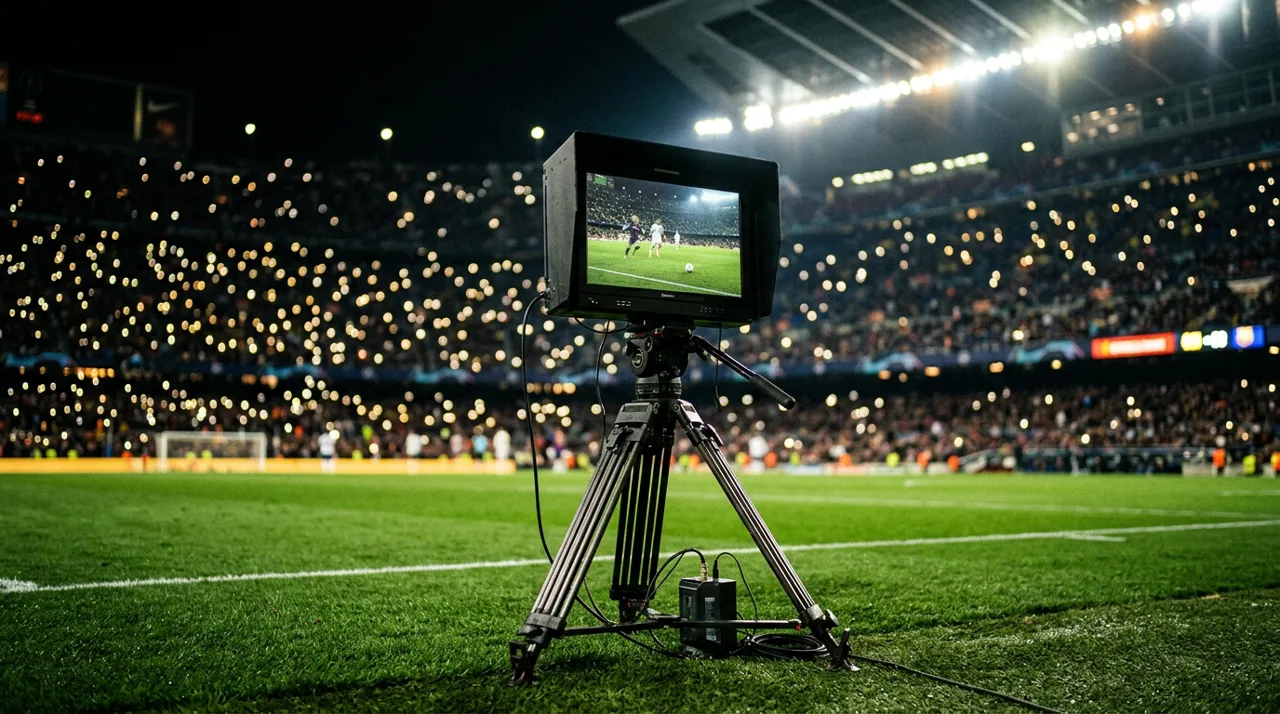
A VAR official faces removal over a gesture controversy at World Cup 2026.
8 min read · 1,553 words
There are moments in a tournament that have nothing to do with football and yet end up defining it. The 2026 World Cup, barely into its group stage, has produced one of those moments — and it involves a VAR official, a hand gesture, and a call from FIFA’s own discrimination monitor for that official to be stood down.
The official at the centre of the storm is Shaun Evans, a VAR operative assigned to matches at the expanded 48-team tournament. According to Sky Sports, FIFA’s discrimination monitor has formally called for Evans to be removed from his duties after he appeared to make a hand gesture associated with white supremacist symbolism. The gesture was captured on broadcast footage and circulated rapidly on social media, prompting an immediate response from anti-discrimination bodies operating inside the tournament.
What Has Been Alleged and What Remains Unclear
The core allegation is straightforward: Evans was seen making a hand gesture that has been widely documented as a white supremacist symbol, most commonly the so-called “okay” sign used in certain far-right contexts. FIFA’s discrimination monitor — an independent body tasked specifically with identifying and reporting discriminatory incidents at the tournament — has concluded the gesture warrants Evans’s removal from officiating duties.
What is less clear is whether Evans made the gesture deliberately or whether this was an inadvertent movement misread in context. That distinction matters enormously, both legally and morally, and it is one that neither FIFA nor Evans’s representatives have fully resolved in public statements as of the time of writing. Sky Sports reports the call for removal but notes that FIFA has not yet confirmed whether Evans has been formally stood down or is under investigation.
Intent is notoriously difficult to establish in these situations. The gesture in question became widely known as a hate symbol partly because it was adopted as a trolling mechanism — a way of deploying plausible deniability. That ambiguity is precisely what makes it so corrosive, and precisely why the discrimination monitor’s position is that the appearance alone is sufficient grounds for removal from a high-profile international role.
FIFA’s Discrimination Framework Under the Spotlight
The incident arrives at a moment when FIFA’s commitment to anti-discrimination work is already under scrutiny. The 2026 tournament has expanded to 48 teams partly for commercial reasons, and the geopolitical tensions surrounding several participating nations have already generated headlines that dwarf anything happening on the pitch. Group G, for instance, features Iran competing despite being at war with co-host nation the United States — a scenario The Independent describes as unprecedented in World Cup history. The tournament has never been short of political complexity, but 2026 has arrived with an unusually heavy freight of it.
Against that backdrop, the handling of the Evans case will be read as a signal. FIFA has invested heavily in the infrastructure of anti-discrimination monitoring at this tournament — the presence of an independent discrimination monitor is itself evidence of that. The question now is whether the institutional response matches the institutional rhetoric. Calling for removal is one thing; acting on that call swiftly and transparently is another.
For context on how the broader tournament is unfolding across its various groups and storylines, FootyGazette’s World Cup 2026 guide has been tracking developments since the draw.
The Broader Tournament Picture
It would be a disservice to the football itself not to note that, away from the Evans controversy, the group stage has been generating its own narratives. Spain, European champions and among the tournament favourites, head Group H alongside Uruguay, Saudi Arabia, and Cape Verde. The Independent notes that Spain are looking to win a second World Cup — their first came in South Africa in 2010 — and the squad assembled by their current coaching staff is arguably the most technically complete they have fielded since that era.
Lamine Yamal, central to Spain’s attacking identity, has been out since April with a hamstring injury but is reported to be back in full training with the squad, according to The Independent’s injury tracker. Whether he is match-ready at the level required to influence knockout football is a separate question, but his presence in training will have settled nerves in the Spain camp. Spain’s xG numbers in qualifying were among the highest in Europe, and their press-and-recover structure under their current setup has been one of the more coherent tactical systems at the tournament.
Belgium, meanwhile, are navigating Group G as favourites despite being a considerably diminished force from the golden generation that reached the 2018 semi-finals. The Independent’s group guide points out that this Belgium side must be assessed on its current merits rather than the residual reputation of a squad that has largely moved on. Iran, Egypt, and New Zealand complete a group that, on paper, Belgium should navigate without crisis — though Iran’s presence carries a political weight entirely separate from their footballing credentials.
Why Officiating Integrity Matters More Than Ever
VAR has been a fixture of elite football long enough that its controversies are now familiar: marginal offside calls, handball interpretations that defy common sense, the interminable wait while a decision is reviewed. What is less familiar is an official at the VAR hub becoming the story for reasons entirely unrelated to a decision they made.
The Evans case matters beyond the individual because it touches on the culture inside officiating structures. Football’s refereeing bodies have historically been opaque institutions — slow to change, resistant to external scrutiny, and not always quick to act when conduct falls below the standard expected. The fact that a discrimination monitor exists at this tournament and has acted publicly is, in one reading, the system working. The question of whether FIFA now follows through is what will determine whether that reading holds.
It is also worth noting that the 48-team format means more matches, more officials, more VAR hubs, and more broadcast coverage of the people operating inside them. The infrastructure of a tournament this size creates exposure that previous World Cups did not generate to the same degree. That is not an excuse for anything — it is simply context for why incidents that might once have passed unnoticed are now captured, shared, and scrutinised within hours.
For those following the tactical dimensions of the tournament, FootyGazette’s analysis of the back three and its modern variants offers some useful framing for how several of the competing nations are setting up defensively, and our explainer on the 48-team format covers how the expanded draw affects knockout qualification routes.
What Happens Next
FIFA will need to respond formally, and soon. The discrimination monitor’s call for Evans’s removal is a matter of public record. Silence or delay will be interpreted as institutional reluctance, fairly or not. The most likely outcomes are either a formal investigation with Evans stood down pending its conclusion, or a finding that the gesture was not deliberate and Evans continues — with whatever reputational damage that decision carries for FIFA’s anti-discrimination credibility.
Neither outcome is clean. The first risks prejudging a man who may have done nothing intentional. The second risks sending a signal that ambiguity is sufficient cover for conduct that, in any other professional context, would trigger immediate review.
What is certain is that the Evans case will not quietly disappear. The tournament has weeks left to run, the spotlight is at its brightest, and the organisations charged with governing the game’s integrity are being watched with rather more attention than they might prefer. That, at least, is how it should be.
FootyGazette will continue to follow developments. For the full picture on how the tournament is taking shape across all groups and storylines, see our summer 2026 storylines hub.
FAQ
Who is Shaun Evans and what is his role at the World Cup 2026?
Shaun Evans is a VAR official assigned to matches at the 2026 World Cup. VAR officials operate in a centralised hub, reviewing footage of key incidents to assist on-field referees with decisions on goals, penalties, red cards, and mistaken identity.
What gesture is Shaun Evans alleged to have made?
Evans was captured on broadcast footage appearing to make a hand gesture associated with white supremacist symbolism. The specific gesture has been widely documented in that context, though its origins as a mainstream symbol mean intent is contested in individual cases.
Has FIFA taken action against Shaun Evans?
As of the time of writing, FIFA’s discrimination monitor has formally called for Evans’s removal from World Cup duties. FIFA has not publicly confirmed whether Evans has been stood down or whether a formal investigation has been opened.
What is FIFA’s discrimination monitor at the World Cup?
FIFA’s discrimination monitor is an independent body operating inside the tournament specifically to identify, document, and report discriminatory incidents. Its presence at the 2026 World Cup reflects FIFA’s stated commitment to anti-discrimination measures at the highest level of the game.
How does this controversy affect the wider World Cup 2026 tournament?
The Evans case adds to a broader set of off-pitch tensions at a tournament already navigating unprecedented geopolitical complexity, including Iran competing against co-host nation the United States. How FIFA handles the Evans situation will be closely read as an indicator of institutional seriousness on discrimination issues.
Where can I watch World Cup 2026 matches?
For information on how to follow the tournament, visit our watch page for details on coverage options, or see our full guide on how to watch football online in 2026.
