
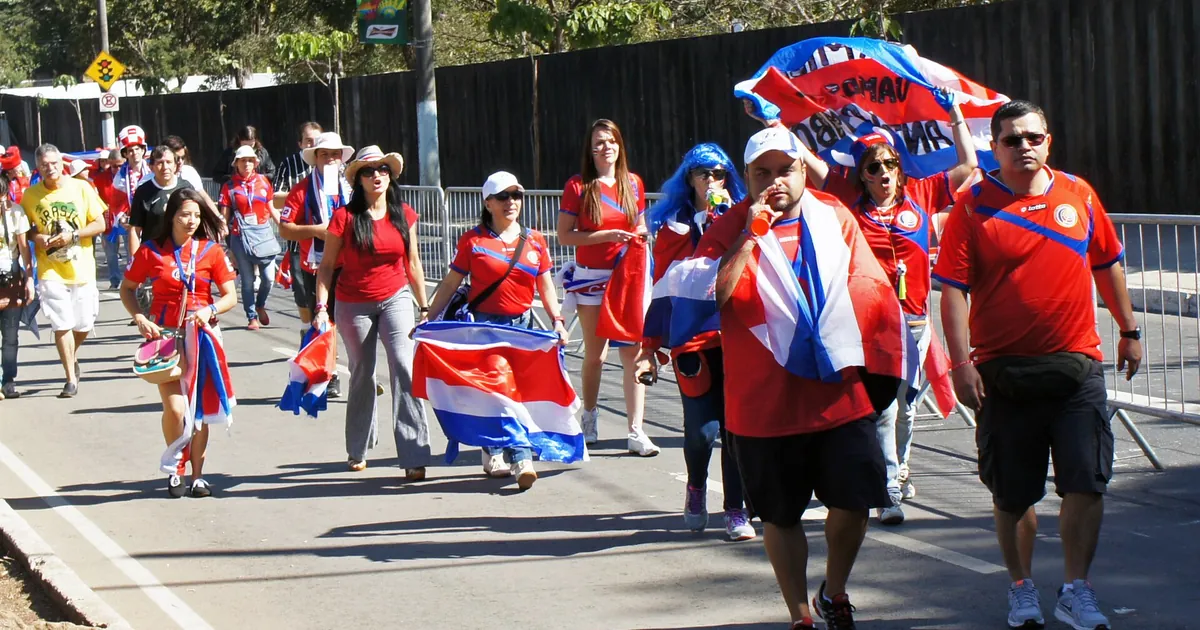
England fans and their flags at a World Cup match. Photo: Mariordo (Mario Roberto Duran Ortiz) / Wikimedia Commons, CC BY-SA 3.0
6 min read · 1,151 words
The first thing England’s travelling support will learn in Dallas this week is not how to find their seats. It is which of their flags they are allowed to unfurl once they get there. The World Cup 2026 flag rules have become the tournament’s quietest scandal: a patchwork of confiscations that no two stadiums seem to enforce the same way, applied to a crowd that FIFA has simultaneously failed to keep apart. The governing body is policing the wrong thing. It is removing harmless banners at the turnstiles while seating rival supporters shoulder to shoulder inside.
It is easy to file this under “officious stewarding,” the sort of grumble that follows every major tournament. It is more useful to read it as what it actually is: evidence that FIFA exercises tight control over the flags it is being watched on, and almost none over the ordinary supporter at the gate.
What the World Cup 2026 flag rules actually say
On paper, the policy is permissive. FIFA’s stadium guidance, summarised by the Football Ground Guide, allows small flags and banners made of fire-resistant material, caps their size at roughly two metres by one and a half, bans flagpoles for safety reasons, and prohibits anything political, offensive or discriminatory. A national shirt is fine. A creative chant is fine. A regional or club flag, in theory, is fine too.
The practice in Dallas has been something else. Ahead of England’s opener against Croatia on 17 June, supporters at Sunday’s Netherlands–Japan game at the same venue reported that flags were removed by staff at the gate, including non-political ones that the code of conduct plainly permits. Ronan Evain, executive director of Football Supporters Europe, was there and did not mince it. “You were not really allowed to bring a flag in, or at least to show it, which is inconsistent with most FIFA rules and regulations, but also what was allowed at previous tournaments,” he told BBC Sport. “That seems to be closer to what is in place for NFL games.”
That last line is the whole story. The people working the gates at an American World Cup are, in most cases, the same people who work the gridiron and the concert calendar the rest of the year. Their default rulebook is the one they already know. FIFA’s own code of conduct leaves the detail vague, never spelling out whether a flag of your city or your club is acceptable, so the local interpretation fills the gap. In Dallas the local interpretation was the NFL’s.
Where FIFA is decisive, and where it isn’t
The revealing part is that FIFA can be perfectly clear about flags when it chooses to be. It just chooses only on the cases that come with lawyers and headlines attached.
This week a Los Angeles court upheld a FIFA position banning Iran’s pre-revolutionary flag from its supporters’ matches, classifying it as a political symbol. In Seattle, where Egypt face Iran on 26 June during the city’s Pride weekend, both nations’ football federations formally objected to local Pride programming, and FIFA held the line the other way: rainbow flags will be permitted inside the venue. The same organisation that once threatened England, Wales and German captains with yellow cards for wearing “OneLove” armbands has, this time, issued clear and centrally-enforced rulings on the symbols that carry political weight.
Hold those decisions next to Dallas and the pattern is obvious. On the symbols that draw courtrooms, federations and rights groups, FIFA has a clear and centrally-enforced policy. On the ordinary fan walking in with a flag of his home town, it has devolved the decision to whichever steward is on the gate and whatever rulebook that steward happens to know. The governing body is present exactly where it is scrutinised and absent exactly where supporters actually live.
The contradiction: over-policed flags, under-policed crowds
That absence has a more serious face than confiscated banners. While staff were stripping flags from supporters who posed no threat, FIFA was presiding over crowds with no segregation at all. Most group games so far have been played with fans of both nations mingling freely, a state of affairs that would be unthinkable in a Premier League fixture or an international qualifier.
Evain’s diagnosis points at the money. “The absence of segregation is not normal for a tournament like this,” he said. “What is worrying is that FIFA doesn’t really know who has tickets here and there, by pushing so much for people to buy tickets and re-sell them. So the possibility, or the risk, to have fans from ‘Team A’ in the middle of the crowd of ‘Team B’ is stronger than ever before.” His verdict on the resale market was that FIFA has “zero control” over where those tickets end up.
FIFA’s response, briefed to BBC Sport, was procedural: participating nations receive a ring-fenced 8% allocation per match, in line with previous tournaments. That is true and beside the point. The 8% guarantees a bloc of known supporters. It says nothing about the other 92%, which has been pushed onto dynamic pricing and resale platforms where the governing body, by its own implicit admission, cannot track the buyer. A ticket that changes hands three times before kick-off arrives at the turnstile as an anonymous barcode, not a fan with a known affiliation. You cannot segregate a crowd you have made anonymous in order to sell its seats more than once.
Why the World Cup 2026 flag rules matter for England in Dallas
For the England supporters converging on Dallas, as many as 15,000 of them by the BBC’s count, the immediate stakes are practical. They will travel with the flags of their towns and their clubs, the soft heraldry of an England away following, and an unknown number will have them taken away under a policy nobody can quote consistently. Football Supporters Europe’s complaint is not that the rules are too strict. It is that there are effectively no rules at the gate, only improvisation, and improvisation at a turnstile tends to default to “no.”
The larger stakes are about what kind of tournament this becomes. FIFA has spent years insisting the 2026 World Cup will be the biggest and most welcoming in history. A welcome that confiscates a fan’s city flag while sitting him next to the opposition without a plan is not hostility. It is something more telling: the selective attention of an organisation that controls what it is judged on and leaves the rest to chance. Before the knockout rounds bring genuinely hostile pairings into these vast, unsegregated bowls, FIFA might decide which of its two flag problems is the one actually worth solving. On the evidence of Dallas, it has the answer backwards.
For more on how the 2026 tournament is being run, see our guide to football’s biggest-ever World Cup, our analysis of how FIFA has redefined the full house, and the surveillance net fans walk into at every host venue.
