
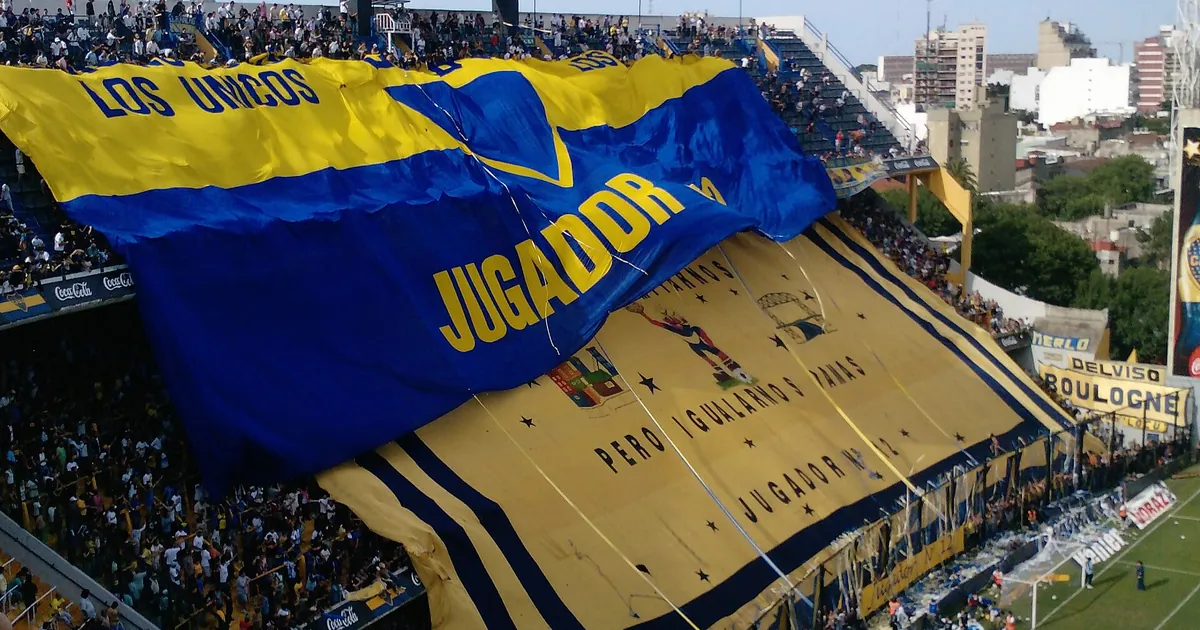
Football's passion travels with its people. Photo: Gonzaloges / Wikimedia Commons, Public domain
6 min read · 1,173 words
At 1.57pm Atlanta time on Sunday, a country of half a million people held the European champions to a goalless draw, and a corner of Georgia lost its mind. Cape Verde, playing the first World Cup match in their history, walked off the pitch at Atlanta Stadium, the tournament name for Mercedes-Benz Stadium under FIFA’s clean-venue rules, to a noise that did not sound like American sport. It sounded like a wedding, a church, a street party in Praia transplanted wholesale to the American South. Their coach, Bubista, had promised the world would see “music, culture, everything,” and as the Guardian’s Sid Lowe reported from the ground, that is precisely what spilled out of the stands.
That afternoon told you more about World Cup 2026 American fans than any television rating will. The tournament that arrived in North America this month is not being carried by the audience the organisers spent a decade courting. It is being carried by immigrants, by diaspora communities, and by the small nations nobody expected to fall in love with. And the gap between the Americans who showed up and the ones who shrugged is turning into the most revealing story of the summer.
The American fans who showed up
Go where the noise is and you find the same thing in every host city. In Los Angeles, as LAist reported, South Korea’s opener turned Koreatown into one long block party, families pouring out of restaurants the moment the final whistle blew. In Boston, crowds of mostly young supporters have gathered outside France’s downtown hotel to cheer the team as they leave for training, and the roar that greets Kylian Mbappé, the Guardian noted, is “of a different order altogether.” In stadium after stadium, the loudest sections belong to countries playing thousands of miles from home.
This is the football America that has always existed and rarely got the cameras. It is Salvadoran and Senegalese and Croatian and Korean. It watches at 8am without complaint, knows every chant, and treats a group-stage fixture as a once-in-a-generation pilgrimage. We saw the same self-organising energy long before kick-off in the capital’s neighbourhoods, where Washington DC’s diaspora communities built their own World Cup from the ground up. When the Guardian wrote that Americans had been “gifted one last chance” to witness Lionel Messi’s international magic, it captured something real about the country’s relationship with this sport: the people who care most are often the ones who carried it here in a suitcase.
The American fans who shrugged
Then there is the other country. In Houston, local outlets reported, downtown businesses spent the opening days asking where the crowds were, the buzz never quite arriving despite a stadium full of fans a few miles away. Across the state, the Guardian found World Cup fever failing to grip Texas Republicans gathered at their convention, one attendee summing up the mood with a flat “no soccer fans here.” A global event was unfolding inside the state’s own borders, and a large slice of the electorate could not have cared less.
That indifference is not a marketing failure to be fixed with a better advert. It is information. The World Cup’s American constituency was never the heartland sports fan who fills an NFL stadium in autumn. It was always the immigrant family, the second-generation kid, the neighbourhood where three flags fly from the same balcony. The tournament did not fail to reach Texas Republicans. It was simply never speaking their language in the first place.
Some politicians have grasped this faster than the broadcasters. In Texas, Democratic Senate candidate James Talarico launched a Spanish-language television advertisement timed to the World Cup, an explicit bid to reach Latino voters in the precise weeks they are most likely to be gathered around a screen. As the Texas Tribune reported, the calculation is simple: the tournament is a town square, and right now that square is full of exactly the people he wants to talk to.
Why the small nations are doing the heavy lifting
Here is the part the pre-tournament forecasts got backwards. The conventional wisdom held that a North American World Cup would live or die on the giants: Brazil, Argentina, the host nations, the marquee names who move merchandise. Instead, the emotional engine of these opening days has been the debutants and the long-shots. Cape Verde’s draw with Spain. The countries returning after decades away. The teams whose qualification was, as Bubista put it, more than football.
The reason is structural, not sentimental. A 48-team field hands first-time tickets to nations with enormous, tightly knit diasporas in American cities, and those communities convert a single fixture into a civic event. A giant’s fans are spread thin across a vast country and a long history of disappointment. A debutant’s fans are concentrated, mobilised, and experiencing something they genuinely never thought they would see. You can hear it in the difference between a polite ripple and the kind of full-throated roar you only get from someone who waited a lifetime for their country to make it. Scarcity does to emotion what it does to everything else: it raises the price. The expanded format, so often criticised as a money-grab that dilutes the football, has quietly produced some of the most genuine crowds these stadiums will ever hold, precisely because it let the people who care most finally have a team to follow at home.
That inversion has consequences the organisers may not love. If the tournament’s energy lives in immigrant and diaspora communities rather than the broad mainstream, then the heat, the security cordons, the visa friction and the entry-line chaos of these first weeks are not minor logistics. They fall hardest on the very audience holding the whole thing up. A World Cup carried by the people most exposed to its hard edges is a fragile arrangement, and nobody in a blazer seems to have priced it in. The same mismatch is showing up in the ledgers, where, as our own reporting has found, the promised windfall for host-city economies has so far proved a wash.
One tournament, two countries
The lasting image of these opening days will not be a goal. It will be the split-screen: a Cape Verdean choir shaking an Atlanta concourse on one side, a Texas convention hall full of people who did not know a match was on a few hours’ drive away on the other. Both are America. Only one of them came to the party.
For the communities that did show up, this is the summer they have waited a lifetime for, and they are not waiting for permission to enjoy it. For everyone trying to understand why a tournament can feel electric in one postcode and invisible in the next, the answer is the oldest one in this country: football in America has always belonged to the people who brought it, long before anyone else thought to watch.
For everything else happening across the 16 host cities this summer, our complete World Cup 2026 guide tracks the stories as they break.
