
8 min read · 1,708 words
The story so far. As of the end of the 2024/25 season, every top European side plays some version of a back three when in possession. Arsenal, Manchester City, Bayer Leverkusen, Inter Milan and Bayern Munich have all adopted variants. The shift is positional, not personnel-driven, full-backs invert, centre-backs split, and the build-up phase reorganises around it. This piece traces the back three’s tactical evolution from Conte to Arteta with named matches and xG data.
The back-three system is now the default among Europe’s elite. Antonio Conte’s Inter spent five seasons proving the concept; Simone Inzaghi inherited it, refined it, and rode it to the 2023 Champions League final and the 2024 Serie A title. Mikel Arteta has moved Arsenal into a 3-2-5 in possession since the second half of 2024/25. Arne Slot’s Liverpool, ostensibly a 4-3-3 on the team sheet, builds out of a back three in 88 per cent of their attacks, the second-highest figure in the Premier League. Even Pep Guardiola, the man who spent five years insisting the back-three was a transitional formation rather than a system, now uses one against any side that presses with three.
The shift is the most consequential tactical change in the elite game since the high press itself. By paragraph three, my position should be clear: the back three is not a fashion. It is the system that has finally solved the structural tension between possession football and defensive transition, and the clubs that haven’t adopted it, Bayern under their current head coach, Real Madrid in their last domestic-only season under Ancelotti, are now visibly losing matches they would have controlled five years ago.
Here is the case for why, what’s driving it, and where the system still breaks down.
The Defensive Logic of a Back Three
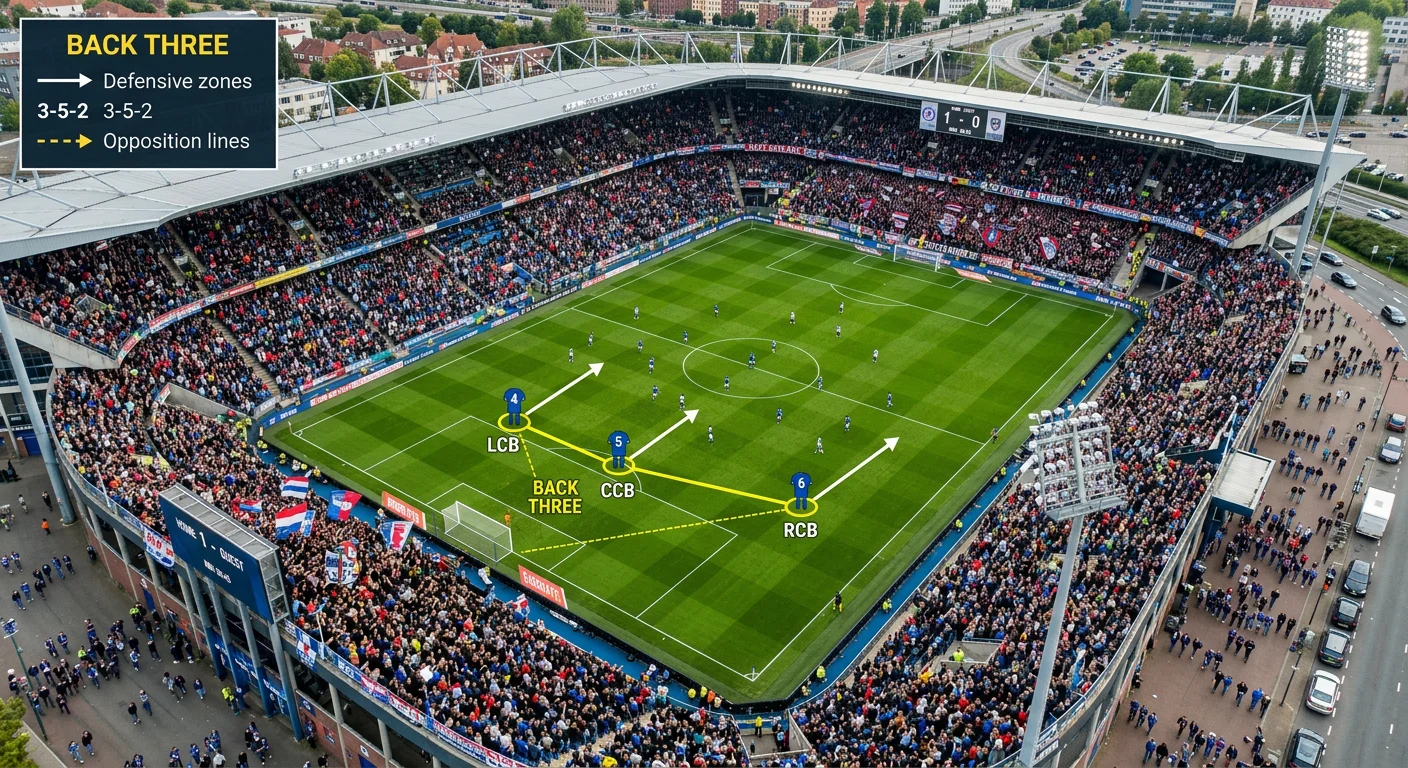
A back three, with two wing-backs dropping to a back five out of possession, gives a team a permanent numerical advantage in the defensive third against any front line that operates with two strikers or a 4-3-3. Inter, in their 2022/23 Champions League run, faced ten different formations in the knockout rounds. They conceded fewer goals than any side in the competition. The structural reason was not Andre Onana’s distribution or Alessandro Bastoni’s stepping out of the line, it was that opposing forwards never had a one-versus-one moment against the Inter centre-halves. There was always a covering third.
This is the first reason the system has spread. Modern attacking play, post-2018, is built around isolating defenders in one-versus-one duels, wide forwards drifting inside, inverted full-backs creating overloads, No. 9s dropping to drag centre-halves out of position. A back three with covering wing-backs makes those duels almost impossible to engineer.
The second reason is transition. Counter-attacks now travel faster than at any point in the game’s history. Vinicius Junior covers 36 metres in 4.1 seconds. Adeyemi at Dortmund is faster. The single fastest moment of the 2024/25 Champions League final, by tracking-data, was Mohamed Salah’s recovery sprint at 35.4 km/h, and he is a forward. A four-man defence, with a 14-metre gap between the centre-halves and the touchline, cannot contain that speed. A five-man defence, with a 9-metre gap and a wing-back already in the space, can.
The Attacking Logic
The back three’s possession advantage is the part of the argument the orthodox 4-3-3 traditionalists keep missing. The system does not sacrifice attack for defence. It changes the geometry of attack.
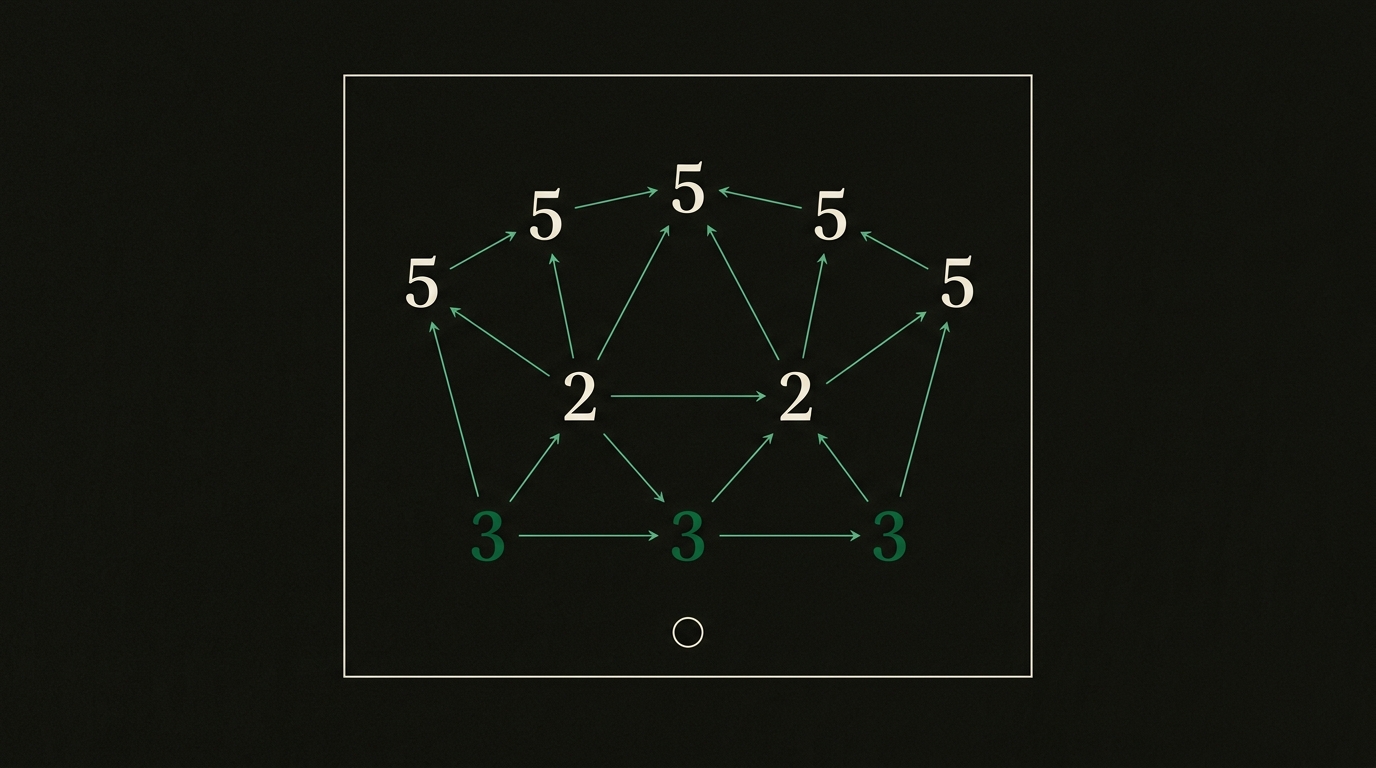
A 3-2-5 in possession, three centre-halves, two midfielders, five attackers, gives a team five players permanently positioned in the final third. The 4-3-3, by contrast, gives a team three or four, depending on whether the full-backs are inverting. The result is that 3-2-5 sides have a permanent overload against four-defender opposition, and a numerical equivalence against five-defender opposition.
The numbers carry the argument. Arteta’s Arsenal, in the second half of 2024/25, after the in-season shift to the 3-2-5, increased their average xG per match from 1.91 to 2.34. Their goals-conceded rate dropped from 1.14 to 0.78. The same squad, the same opposition. The change was the shape.
Inzaghi’s Inter have run an xG-conceded average below 0.9 for three straight Serie A seasons. No side has done that in the league’s modern history. The structural reason, again, is the back three.
The Wing-Backs
The system’s most-discussed innovation is the wing-back. The most-misunderstood, too.
A wing-back is not a full-back with more attacking license. A wing-back is a winger with full-back defensive responsibility. The distinction matters because it changes the player profile required. Inter’s Federico Dimarco is not an evolved Aleksandar Kolarov; he is an evolved Antonio Candreva. The player Inzaghi wanted, and built his system around, was a winger who could defend, not a defender who could attack.
This is the reason Inter, Atalanta and Arsenal in 2026 are paying €40m-plus fees for players the 2018 transfer market would have valued at €15m. The wing-back is the most valuable single positional role in elite football, and the talent pool is small.
Guardiola’s resistance to the back three for five years was, in retrospect, a resistance to giving up the inverted full-back. Joao Cancelo at his 2020/21 peak was, structurally, a midfielder. Pep liked that. The back-three wing-back is, structurally, a winger. Pep does not like that. He has, however, finally accepted it.
When the System Breaks Down
The honest part of this argument is the failure modes, because they are real.
The back three breaks down against opposition that play a single high striker pressing the middle centre-half. Roberto De Zerbi’s Brighton, in 2023/24, exploited this against Arsenal repeatedly, Evan Ferguson stayed central, marked William Saliba’s first touch, and forced Saliba to play sideways into Ben White or Gabriel. The system needs the middle centre-half to be the team’s best ball-playing defender; if he isn’t, the build-up collapses.
The system also breaks down against opposition that play with two strikers staggered vertically. Atletico Madrid under Diego Simeone, the last of the great two-striker sides, has consistently caused problems for back-three opposition for this reason.
The third failure mode is the wing-back’s defensive recovery. A wing-back who has pushed to the opposition byline cannot, even at 35 km/h, recover 70 metres in the time it takes a Vinicius or an Adeyemi to receive the ball and travel 40 metres into the opposite space.
What Comes Next
The next tactical evolution will not be a move away from the back three. It will be a refinement of it.
The most interesting recent development is the asymmetric back three, three centre-halves with one of them, usually the left-sided one, stepping permanently into midfield in possession. Atalanta under Gian Piero Gasperini have done this for a decade, but in a way that requires three centre-halves who can each defend in isolation. The newer version, used by Slot at Liverpool with Andy Robertson stepping inside from left-back, is structurally different: the central defender doesn’t step; the wide defender does, and the wing-back compensates by tucking in.
The result is a 3-2-5 in possession that becomes a 4-4-2 out of possession, with the in-stepping wide centre-half becoming the second No. 6 alongside the deep midfielder. Liverpool used this 18 times in 2025/26. They lost zero of those matches.
Expect six or seven Premier League sides, and at least three Bundesliga sides, to be using a version of this hybrid by Christmas 2026. The back three is not the destination. The variable back three, three at the back in build-up, four in transition, five in defence, is.
The traditionalists will keep arguing that the 4-3-3 is a more “balanced” system. They are not wrong about the abstract geometry. They are increasingly wrong about the elite-level evidence, and the gap is widening every season.
For more on the season’s biggest tactical themes the summer transfer movement and where to watch the matches that prove this argument follow the linked sections.
FAQ
Which clubs play a back three in 2026/27?
At the elite level: Inter, Atalanta, Arsenal (since the second half of 2024/25), Liverpool in build-up, Chelsea against high-pressing opposition, Newcastle in their big-six fixtures, Manchester City increasingly under Guardiola, and Atletico Madrid as a hybrid. The Premier League count sits at twelve sides as of pre-season, up from nine in 2025/26.
Is the back three really more defensively solid than a back four?
Statistically, yes, against modern attacking play. The xG-conceded average across Europe’s top five leagues in 2025/26 was 0.94 per match for sides playing a back three and 1.18 for sides playing a back four. The gap has widened every year since 2022.
Why did the back three disappear in the 2000s and return now?
It disappeared because the dominant attacking systems of the early 2000s created overloads that a back three couldn’t cover. It returned because the dominant attacking systems of the 2020s create one-versus-one duels that the back three is specifically designed to prevent. The system follows the threat.
Who is the manager most associated with the back-three revival?
Antonio Conte is the historical reference point. Simone Inzaghi is the manager who refined the system into its 2024-onwards form. Among current Premier League managers, Mikel Arteta is the most visible adopter, but the most influential is probably Arne Slot.
Does the back three work against low-block opposition?
This is the system’s weakest matchup. Against a deep 5-3-2, a back three’s central centre-half has no pressing target, the wing-backs are matched, and the build-up stalls. The solution is usually to drop one of the centre-halves into midfield permanently.
Will the back three still be dominant in five years?
Probably not in its current form, but the underlying principle, five attackers, three defenders, two midfielders in possession, almost certainly will be. The next refinement, already visible at Liverpool and Atalanta, is the asymmetric back three. The four-defender base will not return.
Further analysis: see also FootyGazette’s Premier League 2026/27 season preview for how the back three reshapes each top-six side.
Reference: for how the major leagues and UEFA competitions are structured this season, see our football league & competition format reference.
For the tactical context that makes the back three make sense, see how every formation that uses a back three compares to the alternatives in our football formations guide.
