
6 min read · 1,217 words
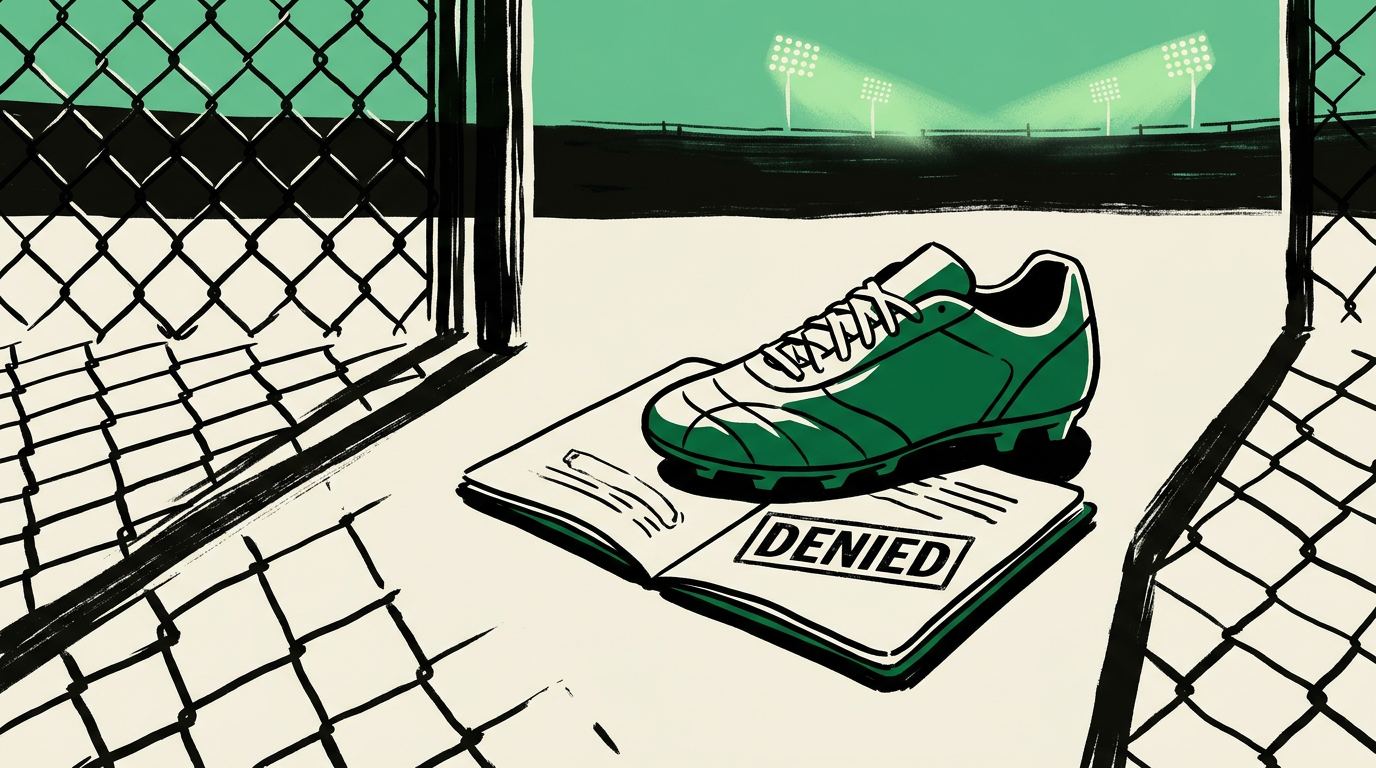
There is a particular kind of absurdity to arriving at a World Cup via the back door, literally, in this case. Iran’s squad touched down at Tijuana airport on Sunday, crossing into Mexico rather than the United States, because a significant number of their support staff had been refused American visas. All three of Iran’s group-stage fixtures are on US soil. Their base camp is not. The team will, in effect, be commuting to their own World Cup matches.
Amir Ghalenoei, Iran’s head coach, did not mince words on arrival. As the Guardian reported he stated plainly that “we should have been here last week because a 12-hour time difference needs two weeks of adjusting.” He went further, suggesting that “ethical and human considerations” had not been respected in Iran’s case, a pointed remark that stopped just short of naming the obvious culprit.
The Iran Football Federation has been rather less diplomatic, labelling the situation “political interference in sport.” That is a phrase FIFA tends to treat with great seriousness, when it suits them. Whether it will here remains to be seen.
What Actually Happened
The mechanics of the dispute are worth unpacking. According to BBC Sport it is not the players themselves who have been denied entry but members of the wider support staff, the kind of backroom personnel who handle logistics, nutrition, video analysis and the hundred other functions a modern international squad depends upon. The players will fly in and out of the United States on match days, returning to Tijuana in between.
That arrangement is, to put it charitably, suboptimal. Jet lag management is a genuine performance consideration at major tournaments. Ghalenoei’s point about the time difference requiring adjustment is not melodrama, it is basic sports science. Arriving late, sleeping in a different country from where you train, and crossing borders on match day introduces variables that no coaching staff would willingly accept.
The US State Department has not publicly explained the refusals. It rarely does. The broader context, strained US-Iran relations that have persisted for decades and sharpened considerably in recent years, does not require much elaboration. Whether the visa denials are a deliberate political manoeuvre or simply the grinding bureaucratic consequence of those relations is, at this point, unclear. The effect on Iran’s preparation is not.
FIFA’s Position and the Broader Principle
This is where things get philosophically untidy. FIFA awarded the 2026 World Cup to a joint bid from the United States, Canada and Mexico partly on the basis that the host nations would guarantee visa-free or visa-facilitated access to all participating nations and their delegations. That guarantee, at least in spirit, appears to have been compromised.
FIFA’s statutes explicitly prohibit political interference in football. The organisation has suspended national associations for less, though it has also, on occasion, looked the other way when the political inconvenience was sufficiently large. A dispute involving the United States, the tournament’s primary host and its most commercially significant market, qualifies as sufficiently large.
The Iran FA’s use of the phrase “political interference in sport” is therefore tactically shrewd. It places FIFA in an awkward position: either acknowledge that the host nation has created unequal conditions for a participating team, or quietly absorb the complaint and hope it goes away before the group stage begins on 11 June. Given FIFA’s institutional track record, the latter outcome is not improbable.
Iran’s Actual Football Situation
It would be easy, amid all this, to lose sight of the football. Iran are not a side to be dismissed. Ghalenoei has built a structured, defensively disciplined team that qualified from the Asian confederation without excessive drama. They are physical, organised, and, when the system functions, capable of frustrating better-resourced opponents.
The disruption to their preparation is, however, real. A support staff operating at partial capacity, a base in a different country from their match venues, and the psychological weight of feeling unwelcome in the host nation, none of that is conducive to peak performance. Whether it materially affects their results is impossible to say in advance, but it is a handicap that no other group-stage participant faces.
For context, consider what a full, undisrupted preparation looks like. Senegal, previewed separately ahead of the tournament, arrived with a refreshed squad and the confidence of a smooth qualification campaign, as the Guardian’s World Cup Experts’ Network noted the Lions of Teranga are aiming to channel that qualification form rather than the turbulence that followed their Africa Cup of Nations campaign. That is what a normal pre-tournament environment looks like. Iran’s is not normal.
The Wider Tournament Picture
The Iran situation sits within a broader set of stories that will define the early days of the 2026 World Cup. Scotland have returned to the finals for the first time since 1998, their qualification built on an extraordinary win over Denmark. England, meanwhile, are fine-tuning their preparations, Thomas Tuchel handing Jude Bellingham the captain’s armband for the second half of a 1-0 friendly win over New Zealand, a gesture that speaks to where Bellingham sits in the team’s hierarchy heading into the tournament.
These are the stories that tend to dominate the pre-tournament conversation: individual narratives, tactical previews, the usual speculation about who will peak at the right moment. The Iran visa dispute is a different kind of story, less glamorous, more uncomfortable, and arguably more revealing about the gap between what major tournaments promise and what they deliver.
The 2026 World Cup is the first to feature 48 teams, a format that brings in nations from confederations that have historically been underrepresented and that, in some cases, have more complicated relationships with the host nations than the organisers perhaps fully anticipated. The expanded format was sold partly on the basis of inclusivity. Iran’s experience in Tijuana is a stress test of that claim.
What Happens Next
A few things are worth watching in the coming days. First, whether FIFA makes any formal statement or takes any action. The organisation’s communications around this have been notably sparse. Second, whether the US authorities grant any of the outstanding visas before Iran’s opening group fixture, which would quietly resolve the immediate practical problem while leaving the principle unaddressed. Third, whether other nations with complicated diplomatic relationships with the United States encounter similar difficulties.
Iran’s players have reportedly expressed their frustration publicly. Ghalenoei’s airport remarks were measured but pointed. The federation’s language has been sharper. None of this is going away before a ball is kicked.
For a tournament that has spent considerable energy presenting itself as a celebration of global football, the image of a World Cup squad based in a neighbouring country because the host nation would not issue visas to their staff is not a comfortable one. It is also, given the geopolitical context, not a surprising one. The surprise, if there is one, is that it was not more thoroughly anticipated and resolved before the teams arrived.
Whether you follow the football through a broadcaster, a streaming service, or by checking our guide to watching football online in 2026 the Iran situation is a reminder that the World Cup exists in the real world, with all the diplomatic friction, bureaucratic intransigence and political calculation that entails. The football, when it starts, will be a welcome distraction. For Iran’s coaching staff, trying to manage a squad across an international border, it cannot come soon enough.
