
8 min read · 1,621 words
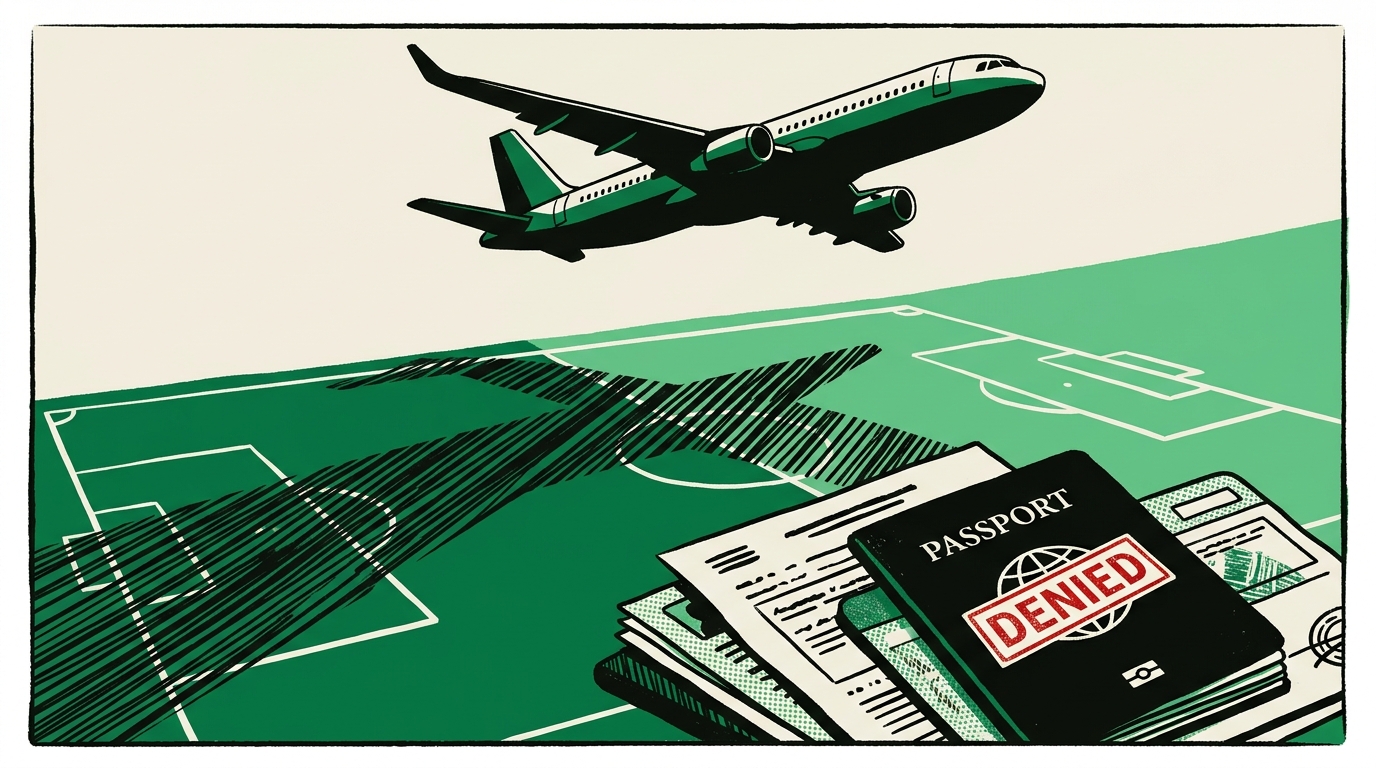
Nine days before Iran kick off their 2026 World Cup campaign against New Zealand at SoFi Stadium in Los Angeles, the team boarded a flight not to the United States but to Mexico. The reason, in the bluntest possible terms, is that several members of their delegation, reportedly including Iranian Football Federation president Mehdi Taj, have yet to receive US entry visas. The players and coaching staff got theirs on 5 June. A significant portion of the support structure around them, apparently, did not.
It is, by any reasonable measure, an extraordinary situation in which to find yourself nine days before a World Cup group-stage opener. And yet here we are.
What We Actually Know
The facts, as verified across multiple sources, are these: Iran spent the past three weeks training in Antalya, Turkey, while diplomatic negotiations over US visas ran in the background. According to the Guardian visas for Iran’s players and some staff were approved on 5 June, but Iranian state media and diplomats reported the same day that several support staff members, including the federation chief, had been excluded. The US State Department’s public position is that all “necessary” visas have been issued, which is a statement carefully worded enough to drive a diplomatic lorry through.
Iran have since departed for Mexico, where they will base their pre-tournament camp. All three of their group-stage matches, against New Zealand on 15 June, then presumably further fixtures to follow, are scheduled to be played on US soil. The logistical implications of running a World Cup camp from one country while playing matches in another are, to put it mildly, suboptimal.
The Disagreements and the Gaps
There is a meaningful discrepancy between what the US State Department is saying and what Iranian officials are saying, and it is worth being honest about the fact that neither side has a spotless record of disinterested accuracy on matters involving the other. The State Department’s claim that “necessary” visas have been issued does not address which staff members were denied, on what grounds, or whether appeals are possible. Iranian state media, meanwhile, has a habit of framing any bilateral friction in the most adversarial terms available.
What is not in dispute: the Iranian federation president was not among those who received visas on 5 June. Whether that constitutes a deliberate diplomatic signal, routine bureaucratic processing, or something in between is genuinely unclear. The timing, days before a tournament the United States is co-hosting, makes the charitable interpretation somewhat difficult to sustain.
It is also worth noting the broader context that the Guardian’s reader survey captured this week: a significant portion of football supporters heading into this tournament are already carrying a sense of unease about the political environment surrounding it. Ticket prices, transport costs, and what one reader called “Trump anger” have complicated the usual quadrennial excitement. The Iran visa situation is, in that context, less of an isolated incident and more of a piece with a broader pattern of friction.
The Football, For What It Is Worth
Iran’s group-stage situation is worth examining on its own terms, separate from the diplomatic noise. They open against New Zealand on 15 June in Los Angeles, a fixture that, on paper, represents their best opportunity for points. The All Whites qualified through the expanded 48-team format and, while not to be dismissed, are not the kind of opponent that should cause Iran’s tacticians sleepless nights under normal preparation conditions.
The problem is that these are not normal preparation conditions. Running a camp from Mexico while key federation officials are either absent or operating under uncertainty is a meaningful disruption to any squad’s rhythm, regardless of how professionally the players and coaching staff attempt to manage it. Pre-tournament preparation, the closed-door matches Iran ran in Antalya over the past three weeks, the tactical work, the squad cohesion, can be undone quickly by administrative chaos in the days immediately before competition begins.
Elsewhere in the pre-tournament picture, BBC Sport reported that Argentina rested Lionel Messi against Honduras, while Germany, Brazil, Belgium and Portugal all recorded warm-up wins. Germany, notably, beat the host nation United States 2-1 in a result that will have raised eyebrows, Leroy Sané’s second-half strike proving decisive according to the Independent with Antonee Robinson’s long-range effort providing consolation but not salvation. The hosts losing their final warm-up to a genuine contender is not a crisis, but it is a data point worth filing.
The broader pre-tournament form picture, then, looks something like this: the traditional heavyweights are ticking over, the host nation has a question or two to answer, and Iran are attempting to prepare for a World Cup from a different country to the one hosting it. The 48-team format, which you can read about in detail in our World Cup 2026 48-team format explainer was always going to produce some chaotic group-stage dynamics. Nobody quite anticipated this particular variety of chaos.
The Editorial Reality
There is a version of this story that treats the visa situation as primarily a football logistics problem, and there is a version that treats it as a political story with football as the backdrop. The honest answer is that it is both, and pretending otherwise does a disservice to readers trying to understand what is actually happening.
FIFA awarded the 2026 World Cup to a joint bid involving the United States at a time when US-Iran relations were already complicated. They have not improved in the intervening years. The question of whether a host nation can effectively deny entry to members of a participating nation’s delegation, and whether FIFA has any meaningful leverage to prevent that, is one the governing body has been conspicuously reluctant to answer directly. FIFA’s public statements on the matter have been, to borrow a phrase, carefully worded.
What FIFA cannot afford, commercially or reputationally, is for this to escalate to the point where Iran’s participation is genuinely threatened. The 48-team format means every group match carries weight, and a forfeit or withdrawal would create sporting and legal complications that would take years to untangle. The more likely outcome is that the remaining visa issues are resolved in the coming days, quietly, with both sides claiming the result they need to claim domestically.
Eduardo Camavinga, meanwhile, is apparently spending his unexpected summer at Harvard Business School, having been omitted from Didier Deschamps’ France squad. One imagines he is finding it easier to get a visa.
What Happens Next
The immediate question is whether the outstanding visa issues for Iran’s support staff, including, reportedly, federation president Mehdi Taj, are resolved before 15 June. If they are not, Iran will play their opening match against New Zealand with a delegation operating across two countries, which is a genuinely novel situation in World Cup history.
The medium-term question is what this means for FIFA’s ability to guarantee participating nations the conditions they need to compete. The 2026 World Cup is the largest in the tournament’s history, spread across three nations with 104 matches over 39 days. The organisational complexity was always going to produce friction. Whether that friction becomes something more serious depends, in this instance, on decisions being made in Washington rather than in football boardrooms.
For Iran’s players, the most useful thing they can probably do is focus on what they can control: their preparation, their shape, their fitness. The closed-door matches in Antalya suggest the coaching staff have been doing exactly that. Whether the administrative situation around them allows that focus to hold is a different question entirely.
If you want to follow Iran’s group-stage matches and the rest of the tournament, our guide to watching football online in 2026 covers your options, and you can check FootyGazette’s watch page for coverage details. For the full tactical and competitive preview of what promises to be a genuinely unpredictable tournament, our World Cup 2026 how-to-watch guide has everything you need.
The football, when it starts, will be worth watching. Getting there, for some delegations, is proving harder than it should be.
FAQ
Why were Iran’s World Cup visas denied for some staff?
The US State Department has stated that all “necessary” visas were issued, but Iranian officials and state media reported that several support staff members, including federation president Mehdi Taj, did not receive visas on 5 June. The specific grounds for any denials have not been publicly confirmed by either government.
Will Iran still play in the 2026 World Cup?
Yes. Iran’s players and coaching staff received their US visas on 5 June and the team has departed for a pre-tournament camp in Mexico. Their opening match against New Zealand is scheduled for 15 June in Los Angeles. There is no indication that Iran’s participation in the tournament is under threat.
Where are Iran based for the 2026 World Cup?
Iran are currently based in Mexico for their pre-tournament camp, having spent the previous three weeks training in Antalya, Turkey. All three of their group-stage matches are scheduled to be played in the United States.
What group are Iran in at the 2026 World Cup?
Iran’s confirmed group-stage opener is against New Zealand on 15 June at SoFi Stadium in Los Angeles. Full group details for the 48-team tournament can be found in our format explainer.
Has FIFA responded to the Iran visa situation?
FIFA’s public statements on the matter have been notably cautious. The governing body has not publicly confirmed whether it has intervened with US authorities on behalf of Iran’s delegation, nor has it outlined what steps it would take if participating nations’ delegations were unable to enter the host country.
How did the USA perform in their pre-World Cup warm-up?
The United States lost 2-1 to Germany in their final pre-tournament friendly, with Leroy Sané’s second-half strike proving decisive. Antonee Robinson scored a long-range consolation. Germany have now won nine consecutive matches heading into the tournament.
