8 min read · 1,599 words
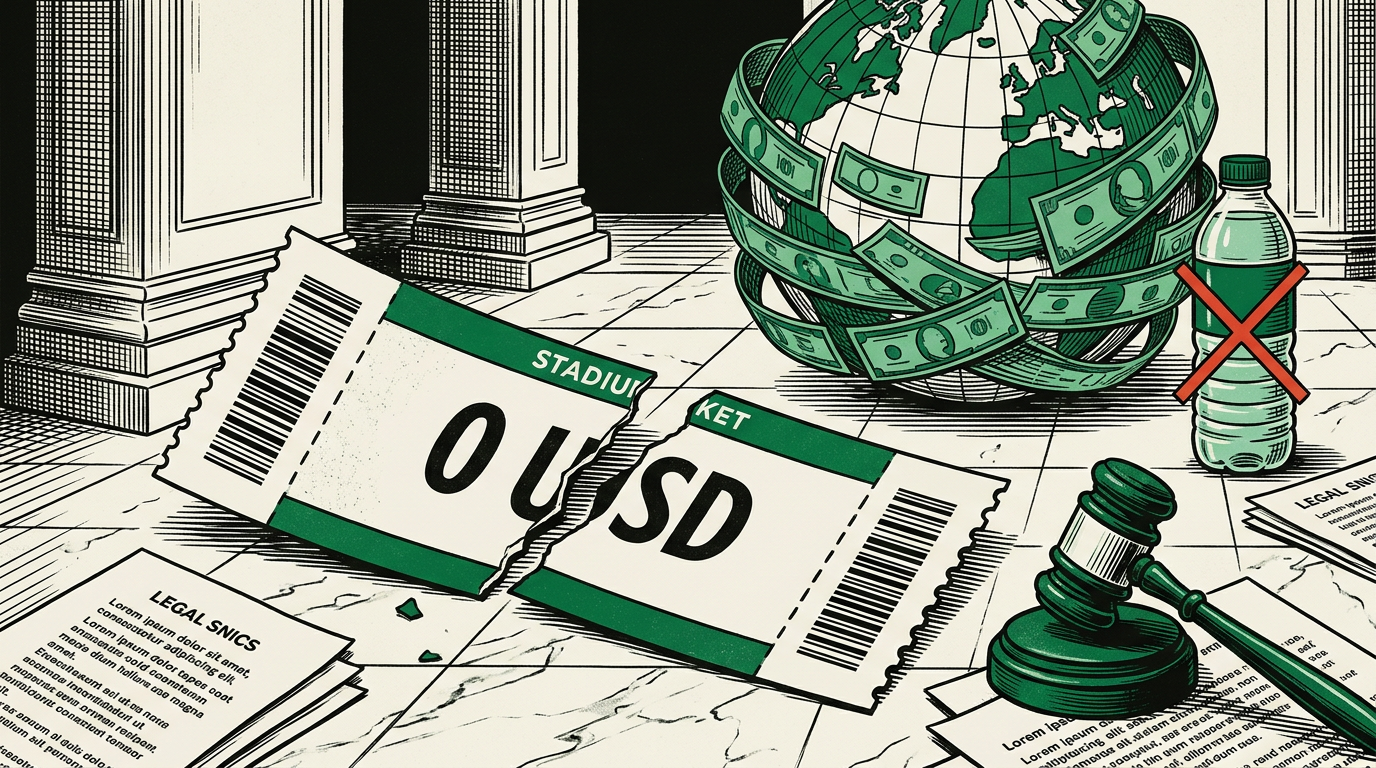
Fifa’s 2026 World Cup begins next Thursday. In the week before kick-off, the governing body has managed to alienate fans who received free tickets by mistake, drawn attorney general scrutiny over its ticketing platform, banned refillable water bottles in summer heat, and quietly distributed $355m to clubs. A busy few days, even by Fifa standards.
The Free-Ticket Fiasco
The headline embarrassment is straightforward enough in its mechanics, if not in its optics. Approximately 60 fans completed checkout on Fifa’s official ticketing platform and were charged $0, a figure Fifa itself confirmed in a statement, describing the allocations as tickets “issued at no charge [0 USD] due to a prior payment issue during the checkout process.” The governing body has since cancelled those tickets and is asking the affected supporters to repurchase them at full price, according to the Guardian.
Fifa says it “regrets” the error. What it has not yet explained publicly is how a payment gateway serving one of the most commercially significant sporting events on the planet, a tournament that will generate revenues comfortably north of $10bn across its cycle, failed to process charges for dozens of transactions before issuing confirmed allocations. That is not a rounding error. That is a systems failure.
The fans involved are, by any reasonable reading, blameless. They completed a checkout process. They received confirmation. The error was Fifa’s. Asking those consumers to now pay full price, for tickets to matches that may already be logistically committed to, with flights and hotels booked, is, at minimum, a public relations catastrophe. At maximum, it is a legal question.
Are attorneys general actually investigating?
Yes, according to the Guardian’s reporting, the ticketing process is being investigated by attorneys general, the chief legal officers of US states, several of which are hosting World Cup venues. The involvement of state-level prosecutors in a consumer protection context is significant. US consumer law is considerably more muscular than most fans in Europe might expect: if Fifa’s platform issued confirmed tickets at a stated price of $0, there is a credible argument that a binding contract was formed at that price. Cancelling those contracts and demanding full payment could, depending on jurisdiction, constitute an unfair trade practice.
Fifa has not commented on the attorney general inquiries specifically. The governing body is headquartered in Zurich, but the tournament is being staged across the United States, Canada and Mexico, meaning US consumer protection statutes are squarely in play.
How many fans are actually affected?
The confirmed figure is approximately 60, which sounds modest until you consider that the World Cup’s total ticketing allocation runs into the millions. The question is not the absolute number but what the error reveals about the robustness of the platform infrastructure. The Independent reported the episode as “a fresh World Cup ticket controversy”, the phrasing “fresh” doing significant work, implying this is not the first such controversy, which it is not. Fifa’s ticketing operations have drawn criticism at multiple tournaments for opacity, secondary-market leakage and allocation irregularities.
What should affected fans do now?
That is genuinely unclear. Fifa’s position is that they must repurchase. The legal position, particularly in states where attorneys general are engaged, may be more nuanced. Fans in affected US host cities would be well advised to document their original confirmation emails and consult state consumer protection offices before repurchasing. This is not legal advice; it is the obvious journalistic observation.
The Water Bottle Ban: A Policy That Defies Explanation
Separately, Prime Minister Keir Starmer has publicly criticised Fifa’s decision to prohibit fans from bringing refillable water bottles into World Cup stadiums. “It’s just wrong,” Starmer told reporters, according to the Independent. The tournament takes place in June and July across venues including Miami, Dallas and Los Angeles, cities where summer temperatures routinely exceed 35°C.
The commercial logic is not difficult to identify: stadium concessions generate significant per-head revenue, and captive audiences unable to bring their own hydration will spend at vendor points. But the optics of a governing body prioritising concession income over basic fan welfare, in extreme heat, at a tournament charging premium ticket prices, are, to put it diplomatically, poor. Starmer’s intervention is notable less for its policy weight (the UK government has limited leverage over Fifa’s stadium regulations at a tournament hosted in North America) and more for what it signals about the political temperature around Fifa’s commercial decision-making.
There is also an environmental dimension that will not be lost on sponsors with sustainability commitments. Banning reusable bottles in favour of single-use plastic sales is a difficult position to square with the ESG language that now saturates major sporting event communications.
The $355m Club Payment: The Number That Actually Matters
Lost somewhat in the noise of ticketing errors and water bottle bans is the more structurally significant financial story: Fifa is distributing $355m to clubs whose players feature in the 2026 World Cup, as BBC Sport reported. This is the Club Benefits Programme, a mechanism by which Fifa compensates clubs for releasing players, and, implicitly, for the injury risk those clubs absorb during international tournaments.
The $355m figure represents a substantial increase on previous cycles and reflects both the expanded 48-team format and the commercial scale of a North American tournament. For context, the entire prize money pool for the 2022 Qatar World Cup was $440m, meaning the club compensation programme alone now represents roughly 80 per cent of that figure. The money flows through Fifa’s club protection programme and is distributed proportionally based on the number of days players spend at the tournament.
For Premier League clubs, who supply a disproportionate share of the world’s most commercially valuable players, this is meaningful revenue. A club releasing ten players who each progress to the quarter-finals is looking at a materially different payment than one whose players exit in the group stage. The incentive structure is worth noting: clubs are, in a narrow financial sense, rewarded for their players’ success, which creates an unusual alignment of interest between club and national team performance. Whether that alignment translates into genuine cooperation on player welfare and workload management is a separate question.
The broader context here is the ongoing tension between Fifa and the European Club Association over the international match calendar. The $355m is partly a political payment, an acknowledgement that clubs bear real costs when their assets are deployed in Fifa competitions. It does not fully resolve the structural dispute, but it represents the current price of a workable truce. For more on how the expanded tournament format reshapes these financial flows, see our guide to the 48-team World Cup format.
AI Moderation: The One Initiative That Looks Genuinely Considered
Amid the governance noise, Fifa’s expansion of AI-driven social media moderation is worth acknowledging as a substantively different kind of initiative. The governing body introduced a social media protection service following the 2022 Qatar tournament and is now offering the moderation component free of charge to all participating football associations at 2026, according to the Guardian’s separate reporting on the programme.
The service works by scanning social media platforms for abusive content directed at players and teams, flagging and filtering material before it reaches the intended recipients. The scale of abuse directed at footballers, particularly along racial and gender lines, during major tournaments is well-documented. Fifa’s decision to offer this at no cost to associations removes the financial barrier that might otherwise prevent smaller federations from accessing it.
Has the Football Association confirmed it will use the service?
No. As of the Guardian’s reporting on 5 June, the Football Association had not confirmed whether it would take up Fifa’s offer. That is a curious omission given England’s well-documented experience of racist abuse directed at players following the Euro 2020 final. The FA’s silence on a free, available tool designed to address exactly that problem will require explanation.
How effective is AI moderation at scale?
The honest answer is: partially. AI content moderation systems have improved substantially but remain imperfect, particularly with coded language, non-English abuse and context-dependent content. The value of the system is less in achieving zero abuse, an unrealistic target, and more in reducing the volume of material that reaches players directly, which has measurable effects on mental health outcomes. Whether Fifa’s specific implementation meets that bar is not yet publicly evidenced.
A Governing Body Running Several Stories Simultaneously
What the past week illustrates is the peculiar dual nature of Fifa’s public presence. On one track, it is a sophisticated commercial operation distributing hundreds of millions of dollars, deploying AI infrastructure and staging the largest football tournament in history across three countries. On the other, it is an organisation capable of cancelling confirmed tickets from ordinary fans and banning water bottles in 35-degree heat.
These are not contradictions so much as reflections of an institution whose governance priorities have historically tilted toward commercial partners and broadcast rights holders rather than the end consumer. The attorney general investigations, if they proceed, will be a test of whether US legal frameworks can impose a different set of priorities on a Swiss-headquartered body operating on American soil.
For fans travelling to the tournament, the practical implications are clear enough: document everything, assume nothing, and read the terms carefully. For a broader look at what to expect from the competition itself, our World Cup 2026 guide covers the full picture, fixtures, venues and format. And for those tracking how the summer’s football calendar connects to the club transfer market, our summer 2026 storylines piece maps the major threads. Information on how to watch football online in 2026 is available separately for those navigating the broadcast landscape.
The tournament starts next Thursday. The governance questions will outlast it considerably.
