
9 min read · 1,772 words
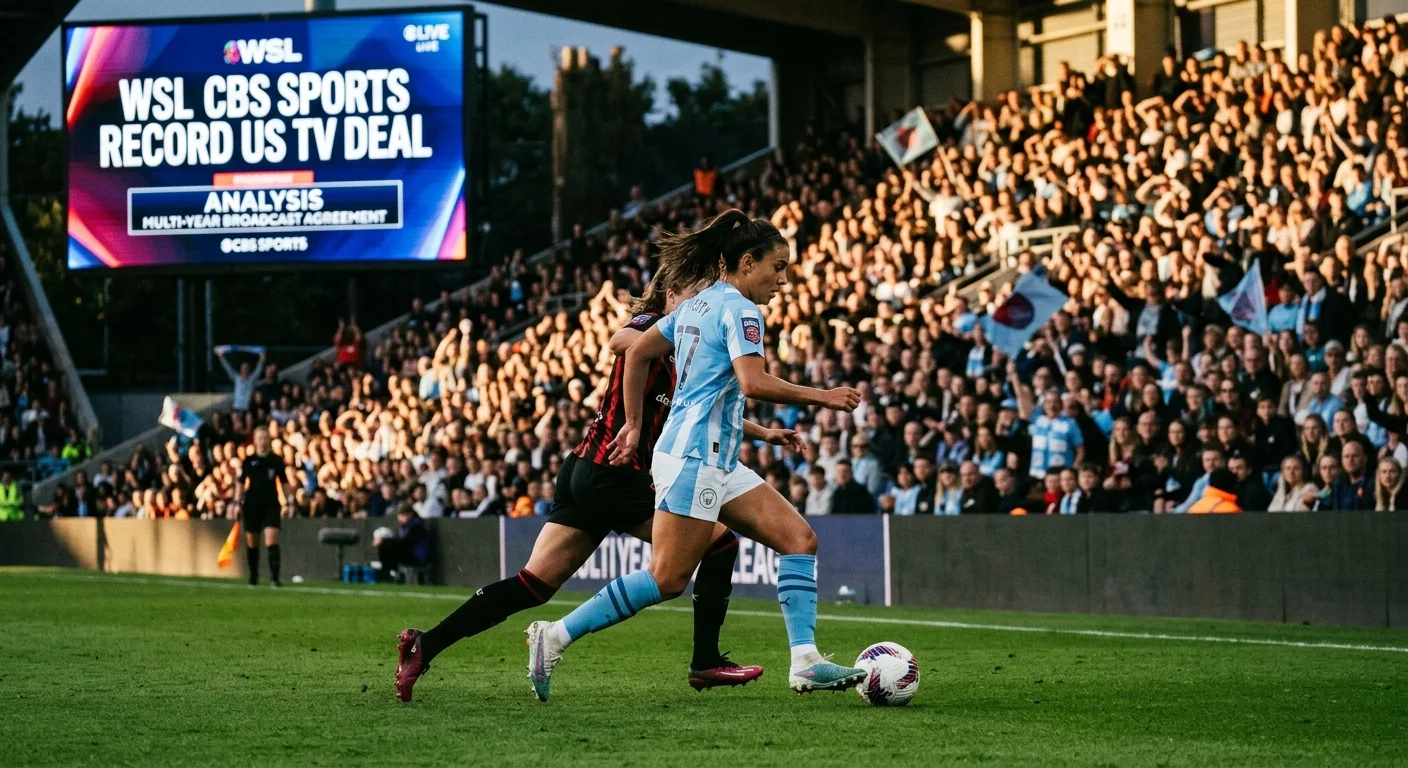
There is a number buried inside Wednesday’s announcement that deserves more attention than the celebratory press releases have afforded it: 183. That is the quantity of Women’s Super League matches Paramount+ has committed to airing in the United States every single season under a new four-year broadcast agreement with CBS Sports, running from next campaign through to the end of 2029-30. One hundred and eighty-three matches. For context, that is more live fixtures than most domestic top-flight packages command in markets where the sport has been commercially established for decades.
The deal, first reported by The Guardian represents a significant structural shift in how the WSL is valued as a media property, not merely as a feel-good story about women’s sport, but as a quantifiable rights asset capable of attracting a major American broadcast partner willing to commit across multiple seasons and multiple platforms simultaneously.
The Architecture of the Deal
What exactly has been agreed?
CBS Sports has acquired the rights to broadcast WSL matches live in the United States across a suite of platforms. Paramount+ carries the bulk of the inventory at 183 matches per season, while CBS Sports Network will air one live match per week. Select fixtures will additionally appear on the CBS Sports Golazo Network, the dedicated football channel CBS launched as a direct response to surging American appetite for the global game. The four-year term, covering 2026-27 through 2029-30, is the longest single broadcast commitment the WSL has secured in the US market, and The Guardian characterises it as a record uplift in the valuation of the league’s overseas television rights.
Why does the multi-platform structure matter?
The distribution architecture here is deliberate and worth unpacking. Paramount+ handles volume, it is a subscription streaming environment where match availability drives subscriber retention. CBS Sports Network provides the linear reach that still matters enormously in American sports media, particularly for audiences over 35. Golazo Network, meanwhile, is the growth play: a free-to-air digital channel targeting the younger, football-native American viewer who grew up watching the USWNT and is now ready to follow club football. Running all three simultaneously is not redundancy, it is audience segmentation. CBS is essentially running three different monetisation strategies against the same rights package, which tells you something about how seriously the network’s commercial team has modelled the opportunity.
The Capital Flow Argument
How does this change the WSL’s financial position?
The WSL’s domestic broadcast deal, currently held by Sky Sports and the BBC, remains the primary revenue engine for the league’s central distribution pot. But overseas rights, historically treated as marginal income, are increasingly where the growth curve sits. The US market is the obvious frontier. Women’s football viewership in America spiked dramatically around the 2023 Women’s World Cup, and the NWSL has since attracted significant private equity interest, with the league’s overall valuation rising sharply. CBS Sports, having watched that trajectory, has made a calculated bet that WSL content can ride the same wave, particularly given that several USWNT players are now based in England, providing a natural narrative hook for American audiences.
For WSL clubs, the downstream effect is what matters. Central broadcast distributions from overseas deals flow through the Football Association and the WSL’s commercial structure. A record deal means more money entering the system, which, in theory, means greater capacity for clubs to invest in player wages, facilities and youth development. The caveat, as ever, is how equitably that money is distributed across the twelve clubs and whether the financial gap between the elite sides and the rest narrows or widens as a result.
Where does this sit in the broader women’s football economy?
The timing is not incidental. The 2026 Women’s Euros will be held in Switzerland, and the 2027 Women’s World Cup is scheduled for Brazil, two major tournaments in a three-year window that will sustain global interest in the women’s game at precisely the moment CBS Sports is building its WSL audience. The network is, in effect, buying into a four-year content cycle that includes two of the sport’s biggest events as promotional tailwinds. That is smart rights acquisition strategy, and it mirrors the logic that drove Amazon’s investment in the Champions League use premium club content to hold subscribers between international tournament peaks.
The WSL deal also arrives as the Premier League‘s own overseas rights packages continue to set benchmarks for how English football is valued internationally. While the men’s and women’s games operate in entirely different commercial weight classes, the institutional knowledge of how to sell English football abroad, built over three decades of Premier League globalisation, is now being applied to the WSL with increasing sophistication.
What Remains Unclear
Has the financial value of the deal been disclosed?
No. Neither CBS Sports nor the WSL has published the monetary terms of the agreement. The Guardian’s report confirms it is a record uplift in rights valuation, but the actual fee structure, whether it is a flat annual rights fee, a revenue-share model, or some hybrid arrangement, has not entered the public domain. This matters because the headline match count (183 per season) tells us about volume commitment but says nothing about yield per match. A deal that delivers 183 matches at a modest per-match fee may be less transformative than the announcement implies; a deal that commands a meaningful premium on previous US rights income is genuinely significant. Until the FA or WSL publish audited accounts that reflect the new arrangement, the precise financial impact remains opaque.
How will production quality and scheduling be managed?
Airing 183 matches per season in a foreign market requires a substantial production and scheduling operation. WSL matches are played predominantly on weekends, with kick-off times calibrated for UK audiences, which means early morning slots on the US East Coast. CBS will need to determine how many of those 183 matches receive full broadcast treatment versus a more stripped-back streaming presentation. The one-match-per-week CBS Sports Network slot suggests the network has identified a flagship product within the broader package, but the production standards applied to the remaining Paramount+ inventory will significantly affect viewer retention and, ultimately, whether the deal is renewed or expanded in 2030.
The Wider Landscape: Clarke and Scotland’s Long Game
Separately, and largely unrelated to the WSL story, Steve Clarke has signed a new contract to remain Scotland head coach until the 2030 World Cup, as confirmed by both BBC Sport and Sky Sports. The deal covers the next two World Cups, 2026 in North America and 2030, as well as the 2028 European Championship. It is a statement of institutional confidence from the Scottish FA in a coach who has delivered Scotland’s most consistent qualifying record in a generation. The contract length also provides planning stability at a moment when Scottish football is attempting to professionalise its national setup more systematically. You can read more about the 2026 tournament in our World Cup 2026 guide.
Forward Look
What happens next for the WSL’s commercial strategy?
The CBS deal is a proof of concept, not a ceiling. If viewership numbers in the US hold up through the first season, and the Women’s Euros in 2026 provide the kind of audience spike that tends to follow major tournaments, the WSL will be in a structurally stronger position when it next negotiates its domestic rights package. Sky Sports and the BBC will be bidding in a market where the league can point to a record overseas deal as evidence of growing global demand. That is a negotiating position the WSL has not previously occupied with such confidence.
There is also the question of what other markets follow. Japan, Australia, and the Nordic countries all have established women’s football audiences. If CBS’s model, multi-platform, high-volume, long-term, demonstrates commercial viability, it creates a template that other broadcasters in other territories can replicate. The WSL’s rights team will be watching the first season’s US ratings with considerable attention.
For those wanting to follow the WSL’s progress as the new deal takes effect, FootyGazette’s guide to watching football online in 2026 covers the current broadcast landscape in detail. The summer 2026 storylines piece also tracks how the women’s game fits into the broader football calendar as the World Cup approaches. And for a structural breakdown of how the men’s elite competition is evolving in parallel, the Champions League 2026-27 format explained provides useful commercial context.
The WSL-CBS deal is, at its core, a capital allocation decision by a major American media company. Paramount+ is betting that English women’s club football can hold a paying subscriber’s attention across a 183-match season. That is a large bet. It is also, given the trajectory of the sport over the past four years, a defensible one.
Frequently Asked Questions
How many WSL matches will CBS Sports broadcast per season?
Under the new four-year agreement, Paramount+ will air 183 WSL matches per season, with CBS Sports Network showing one live match per week and select games also appearing on the CBS Sports Golazo Network, according to The Guardian.
How long does the WSL CBS Sports deal run?
The deal covers four seasons, beginning with 2026-27 and running through to the end of the 2029-30 campaign, the longest US broadcast commitment the WSL has secured.
Has the financial value of the WSL CBS deal been made public?
No. The monetary terms have not been disclosed by either party. The deal has been described as a record uplift in the valuation of WSL overseas rights, but the specific fee structure remains confidential.
Why is the US market so important for the WSL right now?
American interest in women’s football surged following the 2023 Women’s World Cup, and several USWNT players are based in England, providing narrative hooks for US audiences. The 2026 Women’s Euros and 2027 Women’s World Cup will sustain that interest through the deal’s duration.
What does the CBS Sports Golazo Network do differently from Paramount+?
Golazo Network is a free-to-air digital channel targeting younger, football-native American viewers, whereas Paramount+ is a subscription streaming service. Running both simultaneously allows CBS to pursue different audience segments and monetisation models against the same rights package.
How does Steve Clarke’s new Scotland contract relate to the WSL story?
The two stories are largely separate. Clarke’s deal, confirmed by BBC Sport and Sky Sports, extends his tenure through the 2030 World Cup and reflects a different dimension of football’s institutional planning, national team continuity rather than commercial rights. Both stories, however, speak to the sport’s growing confidence in making long-term structural commitments.