
8 min read · 1,744 words
FootyGazette’s anchor piece for the tactical-analysis beat. What we’ll be tracking through the 2026/27 season, and the arguments that actually matter.
Where the tactical conversation actually sits in 2026
Football tactics in the late 2020s aren’t where most of the discourse pretends they are. Open a Monday-night panel show and you’ll still hear the old binaries, possession against pressing, attacking against defensive, “express yourself” against “set up not to lose”. Those arguments were settled some time around the second season of Jürgen Klopp’s Liverpool. They are not what coaches talk about in private any more, and they certainly aren’t what shows up in pre-match team-talks at Arsenal or Bayer Leverkusen.
The interesting arguments now are narrower and more uncomfortable. If you’ve adopted a back three, and almost every top side has, in some in-possession variant, how do you actually defend it when the press breaks? What is your press costing you in expected-goals terms when the underlying numbers suggest it isn’t working that week, against that opponent, on that pitch? When your inverted full-back steps into midfield, who covers the channel behind him, and is the answer good enough against a side with a quick centre-forward and one decent outlet? These are the questions a head coach is asked on a Tuesday morning by an analyst with a clipboard. They’re the questions we’ve started to unpack in our piece on the back three and they’re the questions this hub will keep returning to.
What follows is a map of the tactical themes FootyGazette will be tracking through 2026/27, the structural ones, not the moments, together with the coaches putting them into practice and the data infrastructure that makes the whole thing legible in the first place.
The big tactical themes for 2026/27
Five threads run through almost every interesting fixture of the coming season. None are new in the sense that nobody has done them before. All are new in the sense that they have become the default rather than the experiment.
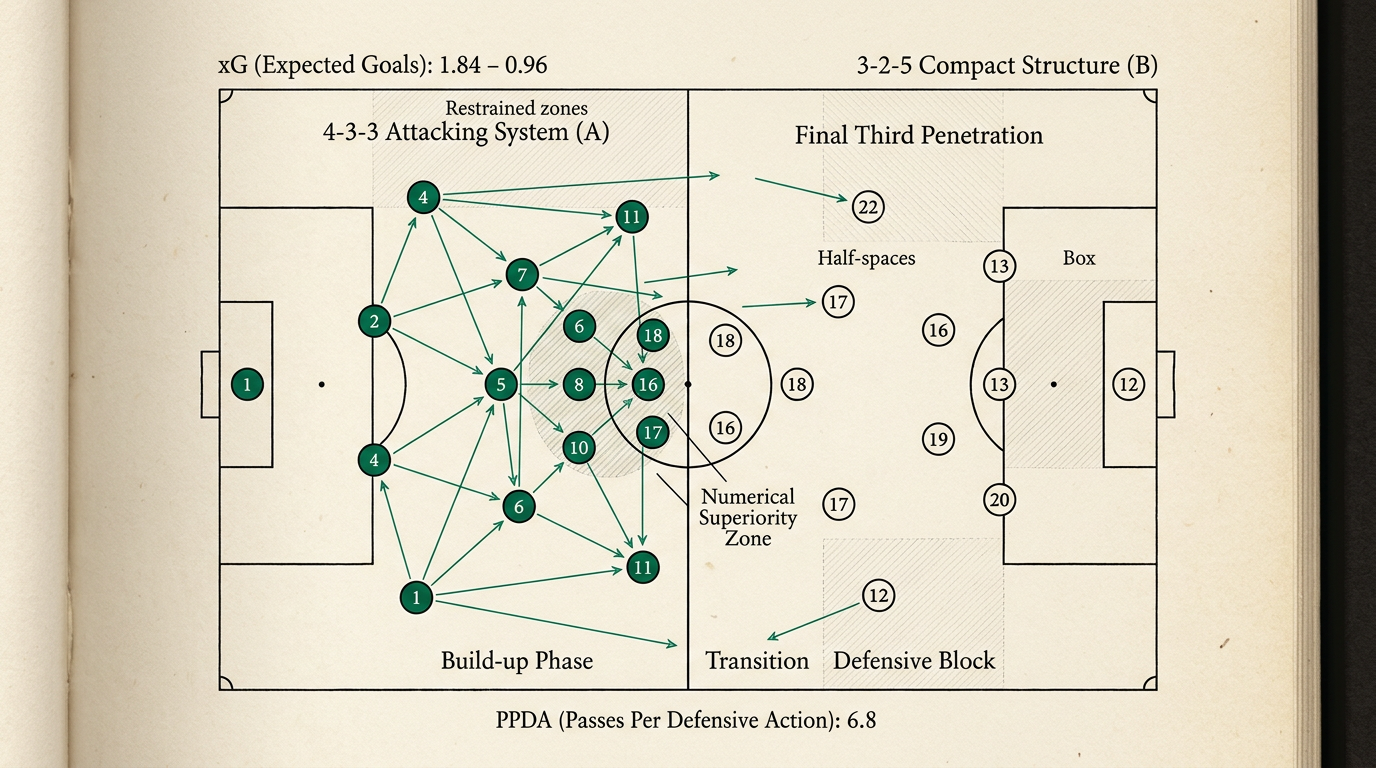
1. Back-three / 3-2-5 normalisation. The 2025/26 campaign was the season every serious European side normalised some 3-2-5 in-possession variant, regardless of whether the team sheet read 4-3-3 or 3-4-2-1. Out of possession it might revert to a back four; in build-up the second pivot drops, a full-back tucks, and you get the familiar 3-2 base with five attacking units in front. We’ve covered the mechanics at length in our back-three tactical analysis; the point for this hub is that the back three has stopped being a system and become a phase.
2. Inverted full-backs reaching their limit. Pep Guardiola’s late-period Manchester City and his Bayern side made the inverted full-back ubiquitous. Every elite club now has at least one. The question for 2026/27 is whether the trick still works when the opposition winger has been coached, drilled and shown video of nothing else for three pre-seasons. Joško Gvardiol’s evolution at City, from inverted full-back to something closer to a third forward, points one way out. Others are quietly going back to orthodox overlap. Worth watching at Arsenal and Manchester City in particular.
3. The false-nine renaissance. Erling Haaland’s positional tweaks across 2024 and 2025, dropping deeper, pulling wide, occasionally vacating the box entirely to drag a centre-back with him, quietly rehabilitated the false-nine principle without the term being used in polite company. Combined with inverted wingers drifting into the centre-forward slot, the most common “modern attack” shape is now a nominal 4-3-3 in which the nine is a rotating concept rather than a fixed body.
4. Set pieces as primary attacking phase. Arsenal’s appointment of Nicolas Jover, and the subsequent set-piece returns that turned them into the league’s most feared dead-ball side, did something more important than win them points. It legitimised the line item. Set-piece coaching is now the highest-marginal-return investment area in elite football, and every serious club has either hired or budgeted for one. Expect more goals from corners in 2026/27, and expect them to look less accidental.
5. The high-press / low-block question post-VAR offside. Semi-automated offside has narrowed the margins on the high line to the point where a runner timing the off the shoulder by a boot length is no longer a coin-flip. That changes the maths. Arsenal, Liverpool Bayer Leverkusen and Bayern Munich remain committed to the high press; Diego Simeone’s Atlético and a fair few others have pushed back the other way, sitting deeper and counting on transition. Both are defensible. The argument is no longer ideological.
The managers driving the tactical agenda
A short, deliberately partial list, these are the names we’ll be writing about most.
Mikel Arteta (Arsenal). Set-piece engineering, pressing triggers cued off the opposition’s first pass into midfield, and a positional discipline that occasionally tips into the dogmatic. Arsenal under Arteta are the closest thing the Premier League has to a teaching side.
Roberto De Zerbi. Positional play in disguise, with build-up patterns that look chaotic on first viewing and turn out, on the rewind, to be choreographed to within a yard. His goalkeeper-to-centre-back baiting routines have been copied more than he’ll be credited for.
Xabi Alonso. The Bayer Leverkusen template, flexible back three, vertical passes through the lines, the kind of patient build-up that doesn’t feel patient when you watch it. The template has now been borrowed across half a dozen leagues.
Hansi Flick (Barcelona). Back in club football and back to the high line and quick vertical attacks that made his Bayern side briefly the best team in the world. Whether the personnel sustains it through a full La Liga campaign is the question.
Vincent Kompany (Bayern post-Tuchel). A more cautious build than the noise around his appointment suggested. Verticality when it’s there; recycling when it isn’t. The early returns reward patience.
Enzo Maresca (Chelsea). Still, frankly, to be determined. The positional structures are immaculate. Whether the squad has the running capacity to sustain them across forty-odd fixtures is the open question.
The data revolution underneath
None of the above is legible without the infrastructure underneath it. StatsBomb, Wyscout, ChyronHego and Opta are the underlying enablers, and the proliferation of metrics they put into the hands of coaches has done more to change the game than any single tactical idea. Expected goals (xG) is mainstream enough that pub commentary uses it, properly or otherwise. Expected threat (xT) and expected assists (xA) are now the working vocabulary of analysts; PPDA (passes per defensive action) is how pressing is actually measured rather than vibed at; final-third entries and progressive carries are how build-up is audited the morning after the match.
Every elite manager now budgets for a “data signing” window in pre-season, a recruit identified less by scouting reports than by clustering against the squad’s existing profile. StatsBomb publishes some of the most accessible reading on the methodology if you want to see how the sausage is made. The structural point: the tactical innovations covered above are downstream of this. The diagrams come from the data, not the other way round.
What FootyGazette covers in tactical analysis
A positioning statement, because it matters.
FootyGazette doesn’t do moments pieces. We don’t write 800 words on the goal; we write 1,800 on the structure that produced it, and on the three preceding sequences in which the same structure produced nothing. Our match analyses follow the team-tactics rather than the score-line, what the build-up shape was in the opening twenty, how it changed at the first drinks break, what the substitution at sixty-three was actually intended to fix. Our manager profiles ask what the tactical principles are, not how many trophies the cabinet holds. Our derby pieces analyse the matchup, who matches up against whom, where the spare man is, which channel gets exploited, rather than the score-line and the noise.
That’s the beat. The tactical-analysis category will grow from here, with the back-three piece as its current cornerstone and this hub as the map.
Frequently asked questions
What is a back three in football tactics?
A back three is a defensive line of three centre-backs rather than the more traditional four defenders. In 2026 it rarely exists as a static shape, most sides use it as an in-possession phase, with a full-back tucking inside or a midfielder dropping to create a 3-2-5 build-up structure, before reverting to a back four out of possession. The longer treatment is in our back-three tactical analysis.
What does “inverted full-back” mean?
An inverted full-back is a wide defender who, in possession, moves into central midfield rather than overlapping down the touchline. The role was popularised by Pep Guardiola at Bayern Munich and refined at Manchester City, and it gives the team an extra body in midfield without sacrificing a defender on the team sheet. It’s now standard at almost every elite club.
What is xG / expected goals?
Expected goals (xG) is a metric that assigns each shot a probability of being scored, based on historical data about shots from similar positions, angles and game situations. A team’s total xG for a match gives a sense of the quality of chances they created, independent of whether those chances were converted. It’s now mainstream enough to appear in television graphics.
Who are the best tactical analysts to read?
Jonathan Wilson’s Inverting the Pyramid remains the historical primer. Michael Cox at The Athletic is the most reliable working analyst in English; Sam Fayyaz writes some of the sharper structural pieces in the same publication. Coaches’ Voice publishes coach-led breakdowns that are unusually candid for the genre.
How has VAR changed football tactics?
Semi-automated offside in particular has tightened the margins on the high defensive line to the point where a runner timing his movement well no longer relies on the linesman’s hesitation. That has made the high press marginally more costly when it fails, and has nudged a handful of sides, Simeone’s Atlético most visibly, towards a deeper defensive block and a counter-attacking outlook.
Conclusion
The tactical-analysis beat at FootyGazette starts here. The back-three piece is the current cornerstone; this hub maps the themes we’ll be tracking through 2026/27, the coaches doing the most interesting work, and the data infrastructure that makes the whole thing possible. For the structural piece on three at the back, see our back-three tactical analysis. For the season ahead in England, the Premier League 2026/27 preview. For the new continental format and what it does to squad rotation, the Champions League format explainer. And for the international context arriving next summer, our World Cup 2026 guide. More to follow, match-by-match, slowly, with the diagrams.
