
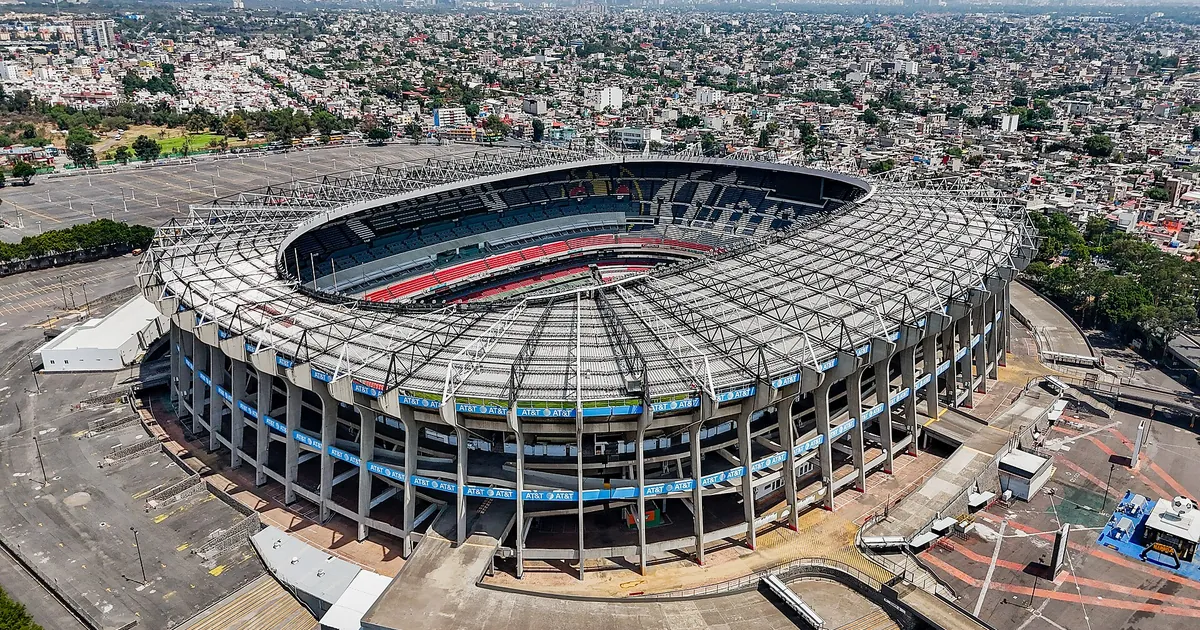
Estadio Azteca, Mexico City. Photo: Own work / Wikimedia Commons, CC BY-SA 4.0
7 min read · 1,340 words
Hours before Mexico’s biggest match of the tournament, someone else showed up at the Azteca first. On the evening of July 4, residents of Santa Úrsula Coapa, the neighborhood pressed against the stadium’s southern flank, staged a blockade near the ground while Mexico City police looked on. Their banners didn’t mention England, altitude, or the Round of 16. They read “El Mundial del despojo,” the World Cup of dispossession, and “FIFA go home.” Reuters and wire photographers covering the buildup to Mexico vs. England caught the demonstration in passing. Almost nobody covering the World Cup 2026 buildup asked why it was still happening on the tournament’s biggest Mexican matchday.
The answer predates the tournament by seven years, and it runs through a water concession most fans have never heard of.
The Concession Behind the Protest
In June 2019, according to reporting from investigative outlet Pie de Página, the Mexican federal water authority Conagua granted a concession, folio 811,078, to Televisa, the broadcaster that owns and operates the Estadio Azteca. The permit allows extraction of 450,000 cubic meters of groundwater a year from a well drilled 350 meters deep, to serve the Coloso de Santa Úrsula, a mixed-use tower development built alongside the stadium as part of its World Cup-driven renovation.
Community wells in Santa Úrsula Coapa run about 80 meters deep. Conagua’s own siting rules require new industrial wells to sit a minimum distance from existing community extraction points; Pie de Página’s reporting places Televisa’s well roughly 370 to 500 meters from the community’s source, and residents argue the deeper well has been steadily drawing down the shallower aquifer that feeds their taps. Pie de Página also reports that federal decrees dating to 1954, predating the stadium entirely, still formally restrict new groundwater perforations in the area. Nobody has enforced them against Televisa’s well.
Rent tells the rest of the story. El Universal and De10 both cite figures showing typical monthly rents in Santa Úrsula Coapa near the stadium climbing from roughly 8,000 pesos to more than 24,000 as construction and tourism pressure intensified ahead of the tournament. Residents describe it as a private displacement running alongside the public one: those who can’t afford the new rent leave, and those who stay increasingly can’t rely on the tap.
A Neighborhood That Has Done This Before
Santa Úrsula Coapa’s relationship with the Azteca is not new. Pie de Página’s history of the neighborhood documents stadium construction beginning in 1962 and a police-led eviction on September 13, 1966, months after the Azteca’s own inauguration that May, when informal wood-and-sheet-metal homes nearby were cleared by force. Sixty years later, residents organizing under the Asamblea Vecinal contra las Mega Construcciones en Tlalpan y Coyoacán argue the pattern never stopped, it just changed instrument: forced eviction in 1966, aquifer depletion and rent inflation in 2026.
The Asamblea’s spokesperson, Natalia Lara, laid out the same framing in an El Universal report on the group’s first organized action, a “posada,” a festive Christmas gathering staged in protest under the stadium’s overpass on December 7-8, 2025, months ahead of the tournament’s June 2026 kickoff. “Para nosotros es el Mundial del despojo,” she told the paper, for us it’s the World Cup of dispossession. In the same report, she added a blunter line from an earlier protest banner, “no puede haber juego limpio en tierra despojada,” there’s no fair play on stolen land, and said organizers had received no answer on their central demand: “no hemos recibido ninguna respuesta por parte del tema de expropiación,” no response on the expropriation question.
That demand hasn’t moved since. The Asamblea wants President Claudia Sheinbaum to expropriate Televisa’s well and reclassify the water as a public utility rather than a private commercial concession, grounded in Mexico’s constitutional recognition of water as a human right. Organizers have also invoked ILO Convention 169’s consultation requirements, arguing the community was never meaningfully consulted before the concession was granted. Seven months after that December report, and with a full World Cup now nearly finished, no expropriation has followed.
Why the Expropriation Demand Is Stuck, Structurally
Here’s the detail missing from most of the sympathetic Mexican-press coverage: this isn’t a mayor or governor refusing to act out of indifference. Water concessions in Mexico are administered federally, through Conagua, not by city government. Mexico City’s mayor Clara Brugada, who separately had to answer for the stampede deaths near the Angel of Independence on July 1, has essentially no unilateral authority to revoke a federal water permit inside her own city limits. The expropriation the Asamblea wants requires presidential-level action specifically because Mexico’s water law keeps concession decisions out of local hands.
That’s the whole reason this fight has outlasted three local administrations and is now outlasting a World Cup. Every layer of government close enough to see the dry taps lacks the power to fix them, and the office that holds that power sits far enough away that a stadium blockade is one of the only tools left to make the issue visible. FIFA’s hosting agreements say nothing about water rights adjacent to the venues they certify; the concession predates FIFA’s involvement with the renovated Azteca by roughly three years, and nothing in the record reviewed for this piece suggests FIFA has weighed in on it.
The Pattern FootyGazette Keeps Finding
FootyGazette has found this scope-gap before: an enormous FIFA security budget that covered ticketed venues but not the spontaneous street celebrations nearby, and a well-documented stadium sustainability push that covers only 2.3% of the tournament’s actual carbon footprint. Santa Úrsula Coapa adds the sharper detail those two stories didn’t have: a specific legal reason the gap persists. It isn’t that nobody has proposed a fix, Sheinbaum’s expropriation route is sitting right there, it’s that the one authority able to use it is structurally insulated from the pressure a stadium blockade can apply.
None of it is hidden, exactly. The Conagua filing is public record, the rent data is reported locally, and the Asamblea has been protesting on camera since December. What’s missing isn’t disclosure, it’s jurisdiction: no single authority at the tournament, city, or national level owns the problem cleanly enough to be held responsible for fixing it before the next opening ceremony.
Mexico’s men have not hosted a World Cup since 1986. Whatever happens on the pitch against England, the well roughly 370 meters from Estadio Azteca keeps pumping 450,000 cubic meters of groundwater a year, tournament or not, and the neighborhood that says it lost its water pressure to a stadium-adjacent concession in 2019 will still be arguing with a federal agency about it long after the trophy is lifted somewhere in the United States.
For more on how the tournament’s costs land unevenly on the cities hosting it, see FootyGazette’s Mexico City celebration deaths reporting and our carbon footprint investigation, or the full World Cup 2026 guide.
FAQ
What is “El Mundial del despojo”?
“El Mundial del despojo,” the World Cup of dispossession, is the framing used by residents of Santa Úrsula Coapa, the Mexico City neighborhood adjacent to Estadio Azteca, to describe their experience of the 2026 World Cup. It refers to a 2019 water concession granted to Televisa for a development next to the stadium, which residents say has depleted the community’s shallower wells, combined with rents that have roughly tripled since construction began.
Has FIFA responded to the protest or the underlying water dispute?
No FIFA statement addressing the Santa Úrsula Coapa water concession or the residents’ expropriation demand turned up in reporting reviewed for this piece. The concession predates FIFA’s involvement with the renovated Estadio Azteca by roughly three years, and the dispute sits entirely outside what FIFA’s hosting agreements govern.
What would actually resolve the dispute, and why hasn’t it?
The Asamblea’s own proposed fix, presidential expropriation of the well under Mexico’s public-utility water framework, is legally available. It hasn’t happened because the decision sits with the federal government rather than any office physically close to Santa Úrsula Coapa, and the World Cup’s presence hasn’t changed who holds that authority. Barring presidential action, the tournament’s end is likely to remove the leverage a stadium blockade currently provides, without resolving the underlying concession.
