
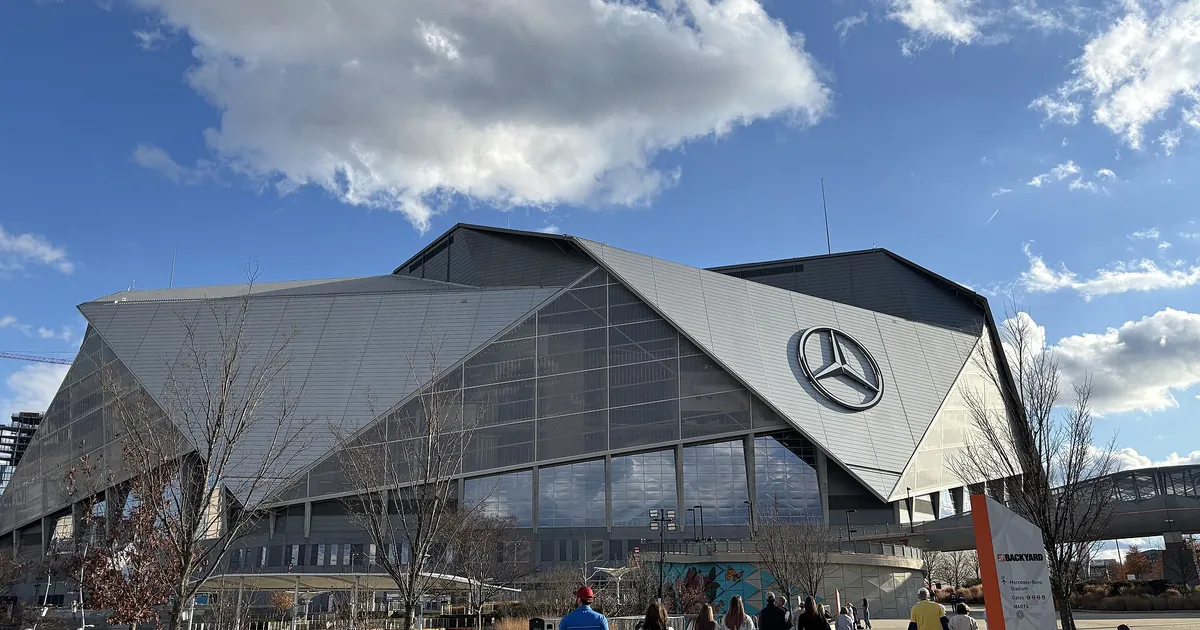
Mercedes-Benz Stadium. Photo: BullDawg2021 / Wikimedia Commons, CC BY 4.0
5 min read · 1,058 words
FIFA has spent two years bragging about the stadiums. Thirteen of the sixteen World Cup 2026 venues are LEED-certified. Mercedes-Benz Stadium in Atlanta runs on more than 4,000 solar panels and became the first professional sports venue in North America to hit LEED Platinum. Water-saving fixtures across the host cities are projected to save over 100 million gallons a year. It’s a genuinely good story, and none of it is made up.
It’s also almost irrelevant to the World Cup 2026 carbon footprint, according to the most detailed independent estimate published so far. Carbon accounting firm Greenly, a commercial platform rather than a peer-reviewed academic body, put the tournament’s total emissions at 7.8 million tonnes of CO2-equivalent in a report released June 4, more than double Qatar 2022’s official figure of 3.63 million tonnes. Stadium construction and renovation, the part FIFA photographs, accounts for 2.3% of that number. The rest comes from somewhere FIFA doesn’t put on a plaque.
Where the World Cup 2026 Carbon Footprint Actually Comes From
Greenly’s bottom-up breakdown, built from publicly available data and disclosed methodology, puts spectator travel at 6.82 million tonnes, 87.8% of the entire tournament. Accommodation adds another 4.7%. Stadium renovations, intra-city transport, food and merchandise, stadium operations, logistics and waste each take a sliver under three percent apiece. Team travel, the flights FIFA and the 48 federations actually control, comes to 17,677 tonnes. That’s two-tenths of one percent.
Sit with that split for a second. The group with almost no say in how the tournament is structured, ordinary fans buying plane tickets, generates 88% of the footprint. The organization that designed a 48-team, three-country format spanning Canada, Mexico and the United States generates a rounding error’s worth of travel itself, then gets to point at its solar panels. Greenly’s report also flags why fan travel ballooned: average return journeys now run around 19,400 kilometers, roughly 50% further than Qatar’s 13,000, a direct consequence of spreading 104 matches across a continent instead of one small country.
FIFA’s Green Stadium Story Is True, and Beside the Point
None of the infrastructure numbers are exaggerated. Reporting from Sustainability Magazine confirms the LEED certifications, the solar installations, and Mercedes-Benz Stadium’s four-million-liter rainwater cistern used for cooling and irrigation. These are real capital investments that will outlast the tournament and keep saving energy for the buildings’ owners long after 2026. That’s worth crediting.
But stadiums were always going to be the easy part of this math. Existing venues, mostly built years before FIFA arrived, cost far less carbon to certify and upgrade than to build from scratch, which is exactly why 2026’s construction share (2.3%) is so much lower than Qatar’s 24.6%, where seven stadiums went up from nothing. FIFA didn’t solve the harder problem. It just picked a hosting model that happened to sidestep the part of the 2022 footprint that made headlines, while quietly creating a much bigger one in a category nobody puts on a scoreboard.
FIFA Has Been Here Before, and Lost
This isn’t FIFA’s first run-in with its own climate claims. In June 2023, the Swiss Commission for Fairness ruled that FIFA’s marketing of Qatar 2022 as “carbon neutral” was false and misleading. FIFA couldn’t prove its offsets were real, additional, or capable of covering the tournament’s actual footprint, and a Columbia Law School analysis of the ruling notes the commission specifically flagged that FIFA’s math ignored the years of stadium operation and maintenance that followed the final whistle. The ruling told FIFA to stop making unsubstantiated neutrality claims. It isn’t legally binding, and nobody fined FIFA a dollar for it.
What’s notable three years later is what didn’t change. No FIFA-issued emissions estimate for 2026 turned up in the reporting or public disclosures reviewed for this piece, audited or otherwise, which leaves an outside firm’s methodology as the only detailed public number anyone has to work with. A commission with no enforcement power told the sport’s governing body its carbon math didn’t hold up, and the structural decision that just doubled the footprint anyway, expanding to 48 teams across three countries, was made and locked in during the very years that ruling was fresh.
The Expansion That Paid for Itself and Priced In the Emissions
The 48-team format isn’t an accident of scheduling. It’s the financial engine of the entire tournament. Sports finance analysts at Caretta Research, cited by SVG Europe, forecast roughly $8.9 billion in total 2026 revenue, a 54% jump over Qatar, driven mostly by the jump from 64 matches to 104. More matches means more broadcast inventory, more sponsorship slots, more hospitality packages and, inevitably, more fans crossing more borders to fill more stadiums. Greenly’s spectator-travel number isn’t a side effect of the expansion. It’s the same decision, measured differently.
That’s the piece missing from most of this month’s carbon coverage. Reports have covered the 7.8 million tonnes and the doubled footprint as a standalone statistic, a bad number the tournament happened to produce. It’s not incidental. It’s the direct output of the format FIFA chose specifically because it maximizes matches, minutes and revenue. You can’t sell three countries’ worth of games and then act surprised that fans had to fly further to watch them.
What Would Actually Change the Math
To be fair to FIFA, there’s no obvious fix that doesn’t also shrink the tournament nobody wants shrunk. Reusing existing stadiums instead of building new ones already cut the infrastructure share dramatically, and that choice deserves the credit it’s getting. But spectator travel is structural to a 48-team format spread across a landmass the size of North America, and no amount of solar wattage at Mercedes-Benz Stadium changes what happens when a fan in Casablanca books a flight to Houston for a Round of 16 match. FIFA could publish its own audited number, submit to independent verification before making any future claim, or simply stop implying the stadium work tells the whole story. So far it’s done none of the three.
The next real test comes in 2030, when Morocco, Spain and Portugal co-host across two continents, and in 2034, when Saudi Arabia hosts alone. A single-country tournament removes the structural driver behind 88% of this year’s footprint almost by definition. Whether FIFA treats that as a selling point, or just another number it doesn’t publish, will say more about whether anything here actually changed than another season of LEED plaques.
For more on how FIFA’s 2026 economics reach beyond the pitch, see FootyGazette’s reporting on the host-city economic impact and the fan festival funding gap, or the full World Cup 2026 guide.
