
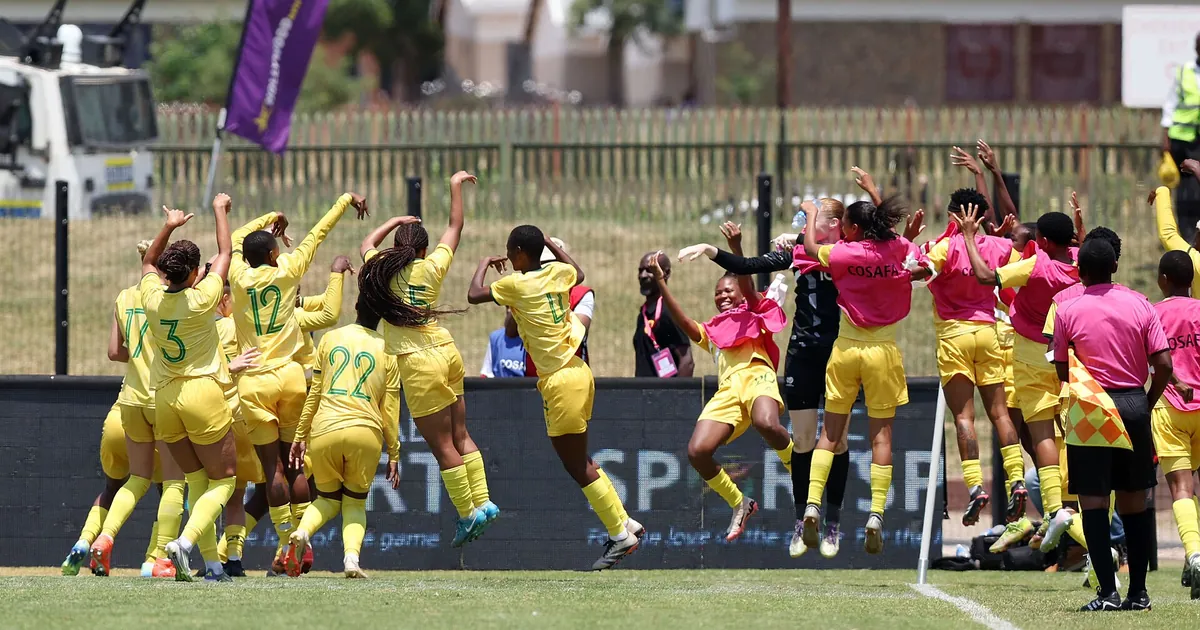
Bafana Bafana celebrate reaching the World Cup knockout stage for the first time. (Wikimedia Commons). Photo: Muzi Ntombela / Wikimedia Commons, CC BY 4.0
6 min read · 1,128 words
Thapelo Maseko plays for AEL Limassol in the Cypriot First Division. On Wednesday night, his goal sent South Africa to the World Cup 2026 knockout stage for the first time in the country’s history, and now his name travels further than his league table usually allows.
Tshepang Moremi pulled the ball back from the byline. Maseko finished. South Korea, who had reached the last eight on home soil in 2002, could not stop it. When the whistle went, South Africa had a 1-0 win, Group A runners-up spot, and a place in the last 32 of the World Cup. For the first time in 28 years of trying. For the first time in their history, full stop.
To understand what Wednesday meant, you have to go back to Johannesburg in 2010.
The 2010 wound that never fully closed
South Africa hosted the World Cup. Soccer City held 84,000 people. The vuvuzelas were so loud that broadcast engineers spent weeks trying to keep them from overwhelming commentary. The whole continent felt as though it had a stake in it.
Bafana Bafana beat France 2-1. They drew 1-1 with Mexico. Then they lost 3-0 to Uruguay and went home. They became the first host nation in the tournament’s 96-year history to be eliminated in the group stage, according to the record. A distinction they held alone until Qatar 2022 shared the ignominy twelve years later. Two host nations, two early exits; between them, that singular failure belonging to South Africa.
Their previous three World Cups had ended identically: 1998 in France, 2002 in Korea and Japan, 2010 at home. Group stage, then bags. When Maseko scored against South Korea, he closed a sequence that had run through three tournaments, a home tournament, and a quarter century of South African football.
Hugo Broos and a squad worth examining
The man who built this team is the oldest head coach in this tournament, a Belgian who led Cameroon to the Africa Cup of Nations title in 2017 and has announced he will retire when South Africa’s World Cup ends, whatever the result. Hugo Broos took over Bafana Bafana in 2021, led them to third place at the 2023 Africa Cup of Nations, and assembled something unusual for 2026: all 26 players in the squad were born in South Africa.
Among the 48 finalists in North America this month, only eight nations brought squads with no foreign-born players. Most associations spend years cultivating diaspora eligibility — players born to immigrant parents, heritage cases processed through federations, athletes who chose a secondary nationality for competitive reasons. Broos chose different. Whether that was coaching philosophy, the reality of the available talent pool, or both, his 26 domestically born players just qualified for the last 32 of a World Cup.
Broos described what they had done as “amazing” after the match. It is hard to argue with that assessment.
Africa’s complicated feelings about Bafana Bafana
There is something worth naming rather than smoothing over. Reporting from fan gatherings in Atlanta in mid-June documented something uncomfortable: supporters from Ghana, the Democratic Republic of Congo, and other African nations declining to back South Africa at this tournament. The reason was not football. It was what has been happening at home.
In recent years, xenophobic violence targeting Zimbabwean, Mozambican, and Ethiopian migrants has left a mark on how other African nations view South Africa’s identity. A Congolese fan in Atlanta told reporters he was supporting Mexico instead. A Ghanaian said he was “a proud African” but that the anti-immigrant sentiment in South Africa needed addressing. GBC Ghana described the situation as geopolitical tensions exposing a fracture in pan-African solidarity.
The complication is that the squad South Africa brought to this World Cup is made up entirely of men born within its borders. No players came from the communities that have been targeted. Whether that makes the situation ironic, irrelevant, or something more complicated is a question each person has to answer individually. The feelings in those Atlanta fan parks were real. So was the goal Maseko scored.
Why they succeeded abroad when they failed at home
The 2010 collapse was not primarily about pressure or atmosphere. South Africa that year were, by any honest assessment, not good enough to finish above Mexico and Uruguay. Hosting gave them the draw and the crowd; it could not give them better players. The squad that arrived carrying a continent’s expectations went home as a footnote, even after beating France.
What Broos built for 2026 is different in character. South Africa were compact, structured, difficult to break down, and quick on the counter. That is how Moremi and Maseko combined against South Korea on Wednesday. The expanded 48-team format helped too — SA lost their group opener 2-0 to Mexico and still advanced. In the old 32-team structure, that defeat might have been fatal.
The format has real critics. Too many low-stakes group games. Too many certain qualifiers. Bloated schedules across three countries. These are fair complaints in the abstract. They are harder to maintain if your country spent 28 years trying to reach a knockout round and could not do it even when 84,000 of your own people were watching. The wider door was the door South Africa finally walked through.
There is an argument that this vindicates the expansion. There is a counter-argument that it dilutes the achievement. The honest position is probably that both things are true at once, and that Maseko’s goal does not care either way.

What comes next for Bafana Bafana
South Africa face Canada in the Round of 32 at SoFi Stadium in Inglewood, California. Canada are co-hosts, playing in front of what will effectively be a home crowd. SA will be the visitors again, as they have been at every World Cup they have entered.
Broos will retire when this ends. He brought the oldest international coaching career in this tournament to its highest point through a goal by a Cypriot league midfielder few people outside southern Africa had any reason to follow. The African diaspora across North America has been one of the defining stories of this tournament — joyful and fractured in ways that do not resolve neatly. Bafana Bafana just gave it a new chapter to process.
2010 does not get undone. The vuvuzelas still played, the stadiums were still full, and the host still went home. But something was settled on Wednesday in a group match that South Africa won 1-0 to make history. It took them 28 years, three group stage exits, a tournament on home soil, and eventually a move to someone else’s country. That is the shape of it.
If you are tracking the World Cup 2026 in full, our tournament hub has all the key angles in one place. For the broader question of who is actually making money from this event, read our analysis of the host-city economics.
