
11 min read · 2,314 words
There are departures, and then there are departures. When a player who has made 507 appearances, scored 233 goals, a club record, and won the Ballon d’Or twice walks out of the door, it tends to register beyond the usual transfer-window noise. Alexia Putellas has left FC Barcelona after 14 years, her contract expiring at the end of the 2025–26 season. She is 32. The question now is not what she has been; it is what she does next, and what it means for the league that lands her.
Fourteen Years, One Club, One Era
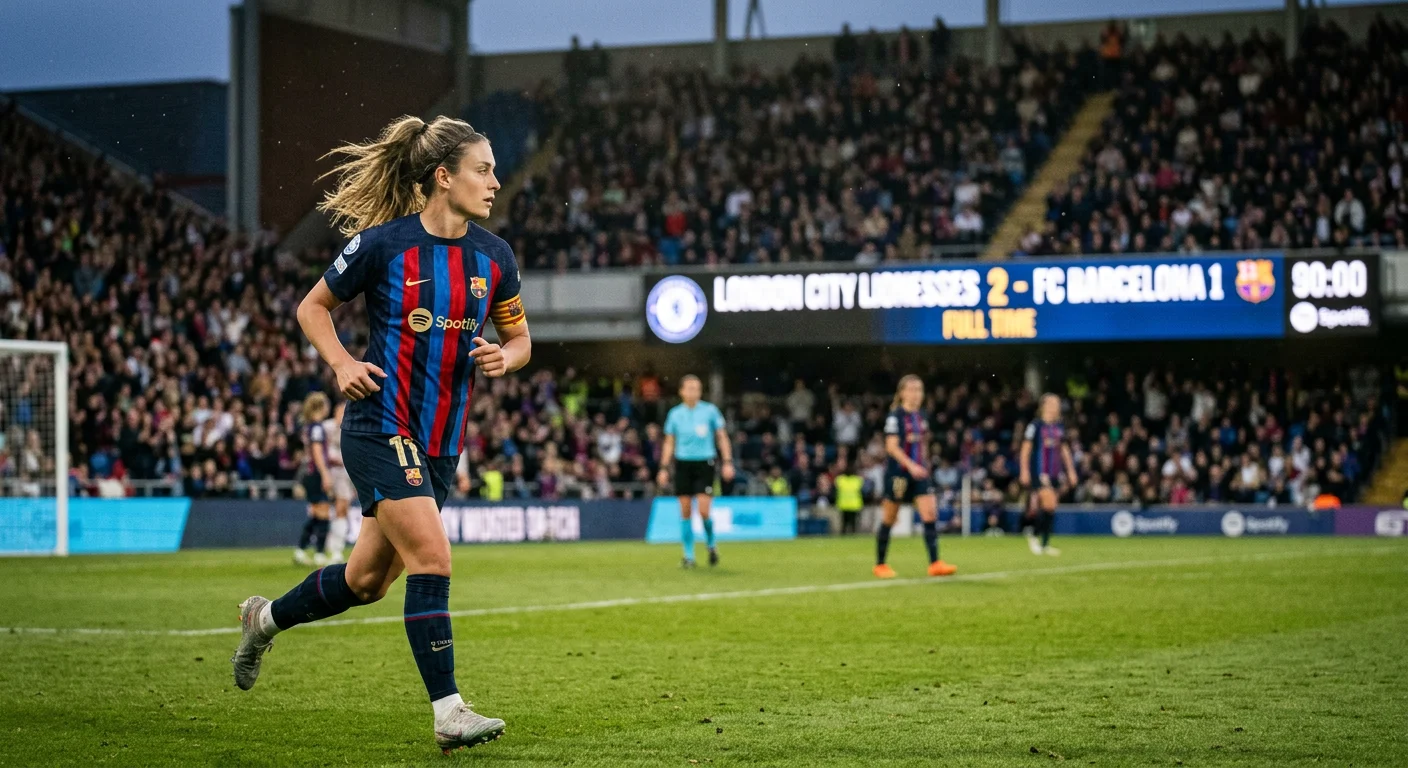
Putellas joined Barcelona from Levante in 2012, aged 18, born in Mollet del Vallès, barely a half-hour’s drive from the Camp Nou. She leaves as arguably the most decorated player in the history of the women’s game, certainly in terms of individual honours. Two Ballon d’Or awards. Multiple UEFA Women’s Champions League medals. A domestic dominance with Barça Femení that redefined what a club women’s programme could look like. The Guardian confirmed Barcelona’s announcement of her exit following the expiration of her contract, noting London City Lionesses as one of several clubs interested in her signature.
The 233 goals she scored for the club is a record that will take some dismantling. More instructive, though, is the manner in which she played: a deep-lying midfielder who could dictate tempo, press high, and arrive late into the box with genuine menace. She was not a centre-forward who happened to score; she was a midfielder who made scoring look like an afterthought. That distinction matters when you are trying to work out how she fits into a new system, at a new club, in a new country.
A Trophy Cabinet That Reshaped the Modern Game
It’s worth pausing on the scale of what she built at FC Barcelona, because the headline numbers undersell it. The two Ballon d’Or wins, in 2021 and 2022, were historic on their own terms. She became the first Spanish woman to claim the award, and she retained it the following year even after a serious knee injury had wiped out most of her season. In 2021 she also collected The Best FIFA Women’s Player and the UEFA Women’s Player of the Year, sweeping the three major individual prizes in a single calendar year before doing something nobody had managed before, holding all three into a second year.
Around those personal honours sits a collective haul that’s almost hard to parse. Multiple league titles in Spain, a long run of Copa de la Reina victories, domestic super cups, and the Champions League medals that turned Barça into the benchmark for the European women’s game. She’s a footballer who has been honoured beyond the pitch too, recognised among the most significant cultural figures in Catalonia. You don’t accumulate that kind of record by being a passenger in a great team. She was, for most of her tenure, the reason the team was great.
Her international story runs in parallel. Putellas was part of the Spain side that won the FIFA Women’s World Cup in 2023, and she lifted the inaugural UEFA Women’s Nations League with her country in 2024. She was in the Spain squad that reached the final of the 2025 European Championship as well. The point isn’t to recite a list. It’s that her career has tracked, almost exactly, the period in which women’s football moved from the margins of the sporting conversation to its centre. She didn’t just witness that shift. She helped drive it.
London City Lionesses: The WSL’s Most Ambitious Project
London City Lionesses were promoted to the Women’s Super League for the 2024–25 season and have since operated with the kind of financial ambition that has made the rest of the division sit up and take notice. The Independent described the potential move as “the WSL’s biggest transfer” which is not a phrase to deploy lightly given the sums that have circulated around the league in recent seasons. Whether or not Putellas ultimately signs for them, the very fact that a club of their relative standing is in the conversation tells you something about the direction of travel in English women’s football.
The Premier League’s financial ecosystem has long cast a shadow, or a glow, depending on your vantage point, over the WSL. London City are backed by investment that has allowed them to move quickly in the market. Signing Putellas would not merely be a statement of intent; it would be a structural shift in how the league is perceived internationally. You do not attract two-time Ballon d’Or winners to a league that nobody watches.
What makes the Lionesses’ rise interesting isn’t only the money. It’s the speed. Plenty of clubs have spent. Fewer have spent while still establishing themselves at the top tier, before the usual rhythms of mid-table consolidation have had time to set in. A newly promoted side chasing a player of Putellas’s standing skips several stages of the conventional growth curve. It’s the football equivalent of a start-up trying to buy a market position rather than earn it slowly, and the league will be watching closely to see whether the gamble pays off on the pitch as well as in the headlines.
Why the WSL Itself Is the Real Story
Step back from the single transfer and the broader picture comes into focus. The WSL has spent the past few seasons turning itself into a genuine destination league rather than a feeder competition. Crowds have grown. Broadcast deals have grown with them. The league that once exported its best talent to Spain, France, and the United States now finds itself in the unfamiliar position of being a place that elite players actively want to join.
A Putellas signing, by any WSL club, would be a marker of that shift more than a cause of it. The league didn’t suddenly become attractive because one player considered a move. The player considered a move because the league had already become attractive. That’s the order of events that matters, and it’s why this story sits in a different category from the speculative links of five or six years ago. Back then, the idea of a reigning Ballon d’Or winner weighing up an English club would have read as fantasy. Now it reads as a Tuesday.
What Does She Offer Tactically?
Can Putellas replicate her Barcelona role in the WSL?
Barcelona’s system under their recent coaches has been built around Putellas as the fulcrum, a player who operates between the lines, receives under pressure, and distributes quickly enough to make the press irrelevant. The WSL is a more physically direct league than the Spanish top flight, and the pressing intensity of its better sides is genuine rather than cosmetic. The question is not whether Putellas has the quality; it is whether the system around her can be constructed to protect her strengths.
How significant is the age factor?
At 32, and having suffered a serious ACL injury in 2022 that kept her out for the best part of a year, Putellas is not the player who was sprinting beyond defences at 28. She has, if anything, become more cerebral, which is not a euphemism for decline, but a genuine tactical evolution. Midfielders of her type often age well, provided the physical load is managed. The WSL’s fixture congestion, particularly for clubs involved in European competition, will be a consideration.
What does her arrival mean for WSL’s global profile?
Women’s football’s commercial trajectory has been steep since the 2022 Euros. Putellas signing for a WSL club, any WSL club, would generate a level of international media attention that the league has not previously commanded from a single transfer. The Champions League implications are also worth noting: if London City qualify for European competition, Putellas would be playing on that stage in English colours, which is a different proposition entirely from a mid-table WSL season.
How would a marquee signing reshape the dressing room?
There’s a less glamorous side to bringing in a player of this calibre, and it tends to get lost in the excitement. A serial winner arriving at a young, ambitious club imports standards as much as ability. Training habits, recovery routines, the small unglamorous decisions that separate elite environments from merely good ones, these travel with the player. For a squad still defining its identity, that kind of influence can matter as much as anything she does with the ball. It can also create pressure. The presence of a generational talent raises expectations for everyone around her, and not every dressing room absorbs that smoothly.
The Broader Transfer Landscape
It is worth placing this in context alongside the men’s game, where transfer inflation has become almost comedic. BBC Sport’s assessment of Liverpool’s six signings last summer noted a combined outlay of £415 million, a record for a single window by one club. Women’s football is not operating in those numbers yet, but the directional pressure is the same: elite players commanding elite fees, and clubs willing to pay them. The gap between men’s and women’s transfer markets remains vast, but it is narrowing at a pace that would have seemed implausible five years ago.
There is also a cultural dimension here that goes beyond spreadsheets. Putellas is not merely a footballer; she is a figure who has represented a particular vision of what women’s sport can be, technically sophisticated, tactically intelligent, commercially significant. Her next club inherits all of that, along with the scrutiny that comes with it. Recent WSL business has shown the league’s appetite for headline deals, as our coverage of Khadija Shaw’s record deal at Manchester City made clear, and a Putellas arrival would push that conversation onto an entirely new plane.
What Barcelona Lose
Barcelona’s dominance of the women’s game in Spain has been built on a combination of youth development, tactical coherence, and the presence of Putellas as the irreplaceable centre of gravity. Replacing her is not a matter of finding someone who scores 233 goals; it is a matter of finding someone who makes the system function. Those players do not grow on trees, and they are rarely available on free transfers.
The Catalan club will continue to be a force, their infrastructure and academy are too strong for one departure to unravel, but the post-Putellas era begins now, and it will require genuine reinvention. For a club that has grown accustomed to defining the terms of European women’s football, that is a non-trivial challenge. There’s also the symbolic weight to reckon with. Putellas wasn’t simply a great player at Barça. For a generation of supporters, she was the face of the women’s side, the name on the back of the shirt, the link between the club’s modern identity and its ambitions. Replacing the football is hard enough. Replacing what she represented may prove harder still.
How Reaction Has Split
Departures of this magnitude rarely produce a single tidy narrative, and this one is no exception. For neutrals, the prospect of a Ballon d’Or winner testing herself in a new league is straightforwardly exciting, the kind of move that lifts the profile of everyone involved. For Barcelona supporters, the emotions run more complicated, pride in what she gave the club sitting uneasily alongside the disappointment of seeing her leave on a free. And for the WSL, the reaction has been something closer to validation, proof that the league can credibly compete for the very best in the world rather than simply developing talent for others to enjoy. All of those responses can be true at once, which is usually a sign that a story genuinely matters.
Frequently Asked Questions
Why is Alexia Putellas leaving Barcelona?
Her contract at Barcelona expired at the end of the 2025–26 season and was not renewed. Barcelona confirmed her departure, though no official explanation for the breakdown in negotiations has been provided by either party.
Which clubs are interested in signing Putellas?
London City Lionesses have been most prominently linked, with The Independent describing any potential deal as “the WSL’s biggest transfer.” The Guardian noted that London City are among several clubs interested, suggesting there is competition for her signature.
How many goals did Putellas score for Barcelona?
Putellas scored 233 goals in 507 appearances for Barcelona, a club record, after joining from Levante in 2012 aged 18.
What has Putellas won during her career?
Her honours include two Ballon d’Or awards (2021 and 2022), The Best FIFA Women’s Player in the same years, and multiple UEFA Women’s Champions League titles alongside a long list of Spanish domestic trophies with Barcelona. Internationally she won the FIFA Women’s World Cup in 2023 and the UEFA Women’s Nations League in 2024 with Spain.
Would Putellas be eligible for WSL competition immediately?
As an EU national signing for an English club, the registration process would follow standard WSL procedures. There are no known eligibility complications, and she would be available from the start of the 2026–27 season assuming a deal is concluded before the campaign begins.
Where can I watch WSL matches featuring London City Lionesses?
Coverage arrangements for the WSL vary by broadcaster and territory. For a full breakdown of how to follow women’s football online, see our guide to watching football online in 2026. FootyGazette subscribers can also check our watch page for current coverage options.
What has been Putellas’s biggest achievement in club football?
Winning back-to-back Ballon d’Or awards in 2021 and 2022 is the headline, but her role in Barcelona’s UEFA Women’s Champions League victories arguably represents the more complete achievement, those required sustained collective excellence over multiple knockout rounds, not merely individual brilliance across a calendar year.